


Crane Electrical Control Systems: What Does Your Crane Actually Need?
Both crane specifications list PLC control, VFD speed control and wireless remote control. Does that mean the cranes can perform the same functions?
Not necessarily. Two cranes may use similar electrical components but have different control functions. The differences lie in which movements are controlled, how the mechanisms interact, and what happens when a fault occurs. A component list alone cannot confirm these capabilities.
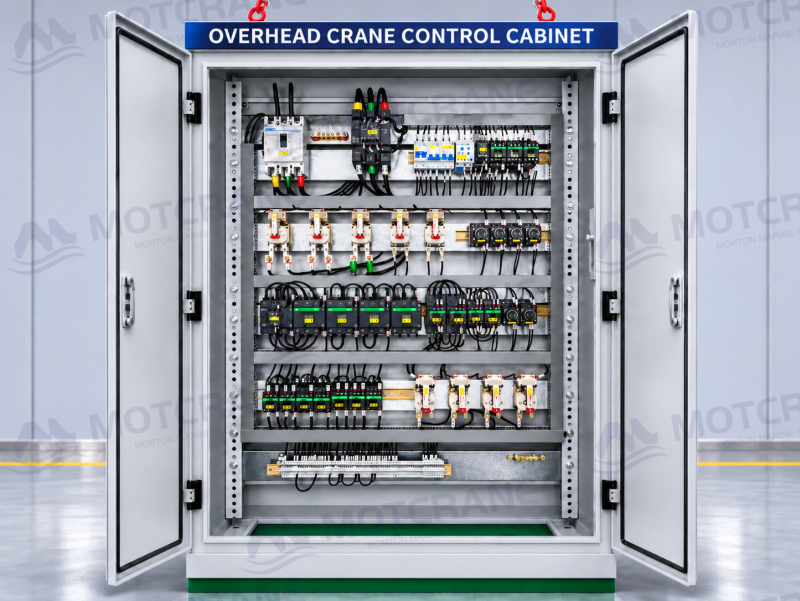
1. What Do Crane Electrical Control Systems Actually Control?
Start by breaking down a typical lifting operation into hoisting, travelling, positioning and setting down the load. Then identify whether each movement is manual, electrically driven or hydraulically actuated.
For example, an electric overhead crane typically requires separate controls for hoisting, bridge travel and trolley travel. A hydraulic gantry crane may need coordinated control of multiple lifting points, together with travel and side-shifting functions. A manually operated mechanism does not require a separate electrical drive system.
For each movement, establish three requirements: who operates it, whether speed control is needed and whether it must be coordinated with other mechanisms.
This helps you define the necessary control functions without adding unnecessary electrical equipment to simple manually operated mechanisms.
2. Why Do Different Drive Systems Need Different Control Approaches?
Electric cranes require coordinated control of motors, drives and brakes. Hydraulic gantry cranes use hydraulic power units, control valves and cylinders, with encoders or other position sensors providing feedback where required.
Consider a multi-point hydraulic lifting system. Commanding several cylinders to rise at the same time does not guarantee that they will move by the same amount. If the load must remain level within a specified tolerance, the control system needs suitable position feedback, coordinated movement and protection against excessive height differences.
A diesel-powered crane may also require an electrical control system. The diesel engine supplies power, but hoisting, travelling or steering functions may still rely on electro-hydraulic controls.
Identify the power source and the mechanisms being driven before deciding which control functions are necessary.
3. How Should You Choose the Operator Control Method?
Wired pendant controls can be suitable when the operator can safely work near the crane or move along with it. Wireless remote control allows the operator to change position according to the lifting route, while cab control may be more appropriate when a fixed operating position is required.
For outdoor sites or areas with potential radio interference, also check that the control device is suitable for the environment and that wireless communication is reliable throughout the operating area.
However, convenience should not be the only consideration.
You need to check whether the operator has a clear view of the load and its travel path, and identify any blind spots. If both cab and wireless remote controls are provided, the system should include appropriate control-station selection and interlocking to prevent simultaneous operation from two stations.
Choose the operating method to suit the lifting task, rather than adapting the work process to the available controls.
4. Which Crane Movements Need More Precise Control?
For electric drive mechanisms used only occasionally, with modest positioning requirements, a basic control arrangement may be sufficient.
If your operation requires frequent low-speed positioning or smooth acceleration and deceleration, two-speed control or variable-frequency drive (VFD) control may be worth considering. For hoisting applications, however, VFD control must also provide the required torque under load and coordinate correctly with the mechanical brake. A VFD alone must not be relied upon to hold a suspended load.
Where accurate load placement is important, define the required low-speed performance, positioning accuracy and stopping behaviour before selecting the drive and feedback arrangement. VFD control alone does not guarantee the positioning performance you need.
Rather than simply specifying “full VFD and PLC control”, identify which movements need variable speed, what positioning accuracy is required and whether multiple mechanisms must operate together.
5. How Should a Crane Respond to a Control-System Fault?
A control system must perform correctly not only during normal operation but also when something goes wrong.
For example, if the wireless remote signal is lost, the control system should remove the affected motion commands and bring the crane to the safe state defined by the risk assessment. Restoring communication must not restart movement without a new operator command.
If power fails during hoisting, the braking and load-holding arrangements must function as designed. On a hydraulic gantry crane, if the height difference between lifting points exceeds the specified limit, the relevant movements should be restricted or stopped according to the approved control logic.
These functions cannot be verified simply because a specification mentions a “safety PLC” or an “emergency stop”.
Your technical specification should therefore define the fault conditions that trigger protective functions, the required stopping or protective actions, and the conditions for reset and restart after the fault has been resolved. For electrical equipment on hoisting machines, IEC 60204-32:2023 provides a relevant technical reference; the required safeguards must still follow the project’s risk assessment and other applicable standards.
FAQ
Q1. Do all electrical control components need to be from the same brand?
No. Component ratings, interfaces, communication protocols and overall system compatibility must meet the design requirements. Components from different brands should not be assumed to be interchangeable.
Q2. Can a crane control cabinet be purchased separately and installed locally?
Yes. Qualified local electrical personnel should install and wire it according to the approved electrical schematics, wiring diagrams and equipment interface requirements, followed by the necessary commissioning and safety-function tests. The responsibilities for supply, installation and commissioning should be agreed in advance.
Q3. Is a high IP rating enough for an outdoor crane control cabinet?
No. Ambient temperature, condensation, salt spray corrosion and heat dissipation also matter. Enclosure protection, temperature management and anti-condensation measures should be selected for the actual operating environment, not just the IP rating.
Conclusion
A suitable crane electrical control system is not necessarily the one with the most components. What matters is that each movement has an appropriate control method and the essential protective functions can be verified.
If you are planning a new crane, tell MOTCRANE which movements need speed control, coordinated operation or special protective functions. For an existing crane retrofit, send any available electrical schematics, control cabinet photos and key component details. If the drawings are unavailable, the existing wiring and equipment configuration will need to be checked on site.
We can review the required control functions, identify potential compatibility issues and help develop an electrical control configuration and quotation suited to your application.



 English
 Russian
 French
 Spanish
 Arabic
 Indonesian
 Japanese