


Main and Auxiliary Hoists on a Double-Girder Overhead Crane: Do You Need Both?
Why do some double-girder overhead cranes have only a main hoist, while others are also fitted with an auxiliary hoist?
Comparing hoisting speeds and rated capacities alone does not tell you how these configurations will perform in everyday operation. An auxiliary hoist can help you handle heavy and light loads more efficiently, but the trolley layout and control system may restrict the movements you expect the two hooks to make.
Before specifying an auxiliary hoist, you need to understand what each hoist can do and how the two are allowed to operate. If both hooks must work together, a simple sketch showing the lifting points and sequence of movements will help clarify your requirements.
1. What Do the Rated Capacities of the Main and Auxiliary Hoists Mean?
On a double-girder overhead crane, the main hoist generally handles heavier loads, while the auxiliary hoist has a lower rated capacity and is intended for lighter lifting tasks.
The rated capacities apply to the two hoists individually. You cannot simply add them together to determine the crane’s maximum lifting capacity.
Two questions need to be kept separate: how much each hook is rated to lift, and how the two hoists are permitted to operate.
The first depends on each hoist’s rated capacity and specified operating conditions. The second also depends on the crane structure, permitted load combinations and control system. Capacity figures alone cannot tell you whether both hoists may operate simultaneously.
2. When Is an Auxiliary Hoist Worth Adding?
To decide whether an auxiliary hoist is worthwhile, start by looking at the weights and frequency of your routine lifting tasks.
For example, consider a 50-tonne overhead crane that occasionally handles equipment weighing 40–50 tonnes but regularly moves components weighing 5–10 tonnes. An appropriately rated auxiliary hoist may make these routine lifts more practical. Its hoisting speed and positioning performance should be selected to suit those tasks.
If lighter lifts are infrequent and the main hoist can handle them efficiently, a main-hoist-only configuration may be more economical, with one fewer hoisting mechanism to maintain.
An auxiliary hoist is not necessarily faster than the main hoist; actual speeds depend on the selected configuration.
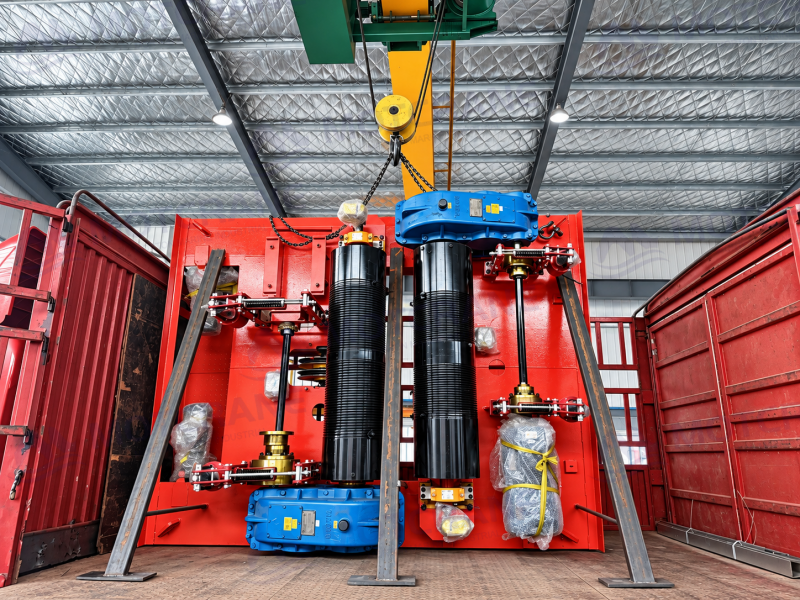
MOTCRANE has supplied a 50/20-tonne double-girder overhead crane for a project in Turkey. This arrangement was selected for that project’s requirements and is not a standard configuration for every 50-tonne crane.
3. Can the Main and Auxiliary Hooks Lift the Same Load Together?
Operating the two hooks independently does not mean they are designed to lift the same load together.
For example, consider a long piece of equipment weighing 45 tonnes that needs to be lifted from two points. Even with a 50-tonne main hook and a 20-tonne auxiliary hook, you cannot determine whether the operation is feasible from the total load weight alone.
You must verify the load’s centre of gravity, the spacing between lifting points and the load carried by each hook. If the equipment must be tilted or turned over, the forces on the lifting points may change throughout the movement.
Operations requiring synchronised lifting or controlled changes in relative hook height need a control arrangement designed for that purpose. Permitted loads, movement sequences and protective stopping functions must be clearly defined.
Do not use two hooks to lift the same load without the necessary engineering verification and approval.
4. One Trolley or Two Independent Trolleys?
When the main and auxiliary hoists share one trolley, both hooks travel together along the bridge, and the distance between them is constrained by the trolley design. This arrangement is suitable when the hooks do not need to change their relative positions independently.
If your lifting tasks require adjustable spacing between the hooks, two independently travelling trolleys may be an option.
However, this arrangement requires checks of the minimum trolley approach distance, combined wheel loads and possible interference between the trolleys. Separate trolleys do not automatically provide synchronised lifting capability.
Choose the trolley arrangement based on how the hooks need to move, not simply on their rated capacities.
5. Can the Unused Hook Interfere with Lifting Operations?
When the main hook is lifting a heavy load, the auxiliary hook is normally not in use. Conversely, when lifting with the auxiliary hook, the main hook and its hook block still occupy space.
This becomes particularly important when handling long or irregularly shaped loads. The unused hook or hook block may interfere with the load, lifting attachments or surrounding equipment.
You should therefore consider where the unused hook will be parked, how high it can be raised and whether sufficient clearance remains throughout the other hook’s lifting and travel movements.
A suitable structural layout, designated hook parking positions and clear operating procedures can reduce these risks. The upper hoist limit switch must not be used as a routine stopping point when parking the hook; OSHA 29 CFR 1910.179 also prohibits using hoist limit switches as operating controls in applicable U.S. workplaces.
FAQ
Q1. Can an auxiliary hoist be added to an existing double-girder overhead crane?
Sometimes, but the existing bridge structure, trolley design, wheel loads and electrical control system must be reassessed.
MOTCRANE evaluated adding a 5-tonne auxiliary hoist to an existing 10-tonne metallurgical overhead crane in Algeria. Calculations showed that the existing bridge could be retained, but the original trolley could not accommodate the additional hoisting mechanism. The proposed modification therefore required replacing the original trolley with a 10/5-tonne winch trolley.
Q2. Do the main and auxiliary hoists need separate remote controls?
No. A suitably configured control station can operate both hoists. On many QD-type double-girder cranes with winch hoists, cab operation is common, while wireless remote control can also be specified. Where both control methods are provided, interlocks must ensure that only one control station can operate the crane at a time.
Q3. Can the auxiliary hoist be used while the main hoist is under maintenance?
It depends on the scope of maintenance and the crane’s design. The auxiliary hoist may only be used when the operation is expressly permitted and can be performed safely. If maintenance affects shared mechanisms or safety systems, the crane must remain out of service until safe operation can be confirmed.
Conclusion
Whether you need an auxiliary hoist depends on the tasks your crane must perform, not simply its rated capacity. Consider what each hook will handle, whether they need to work together and how their positions and movements affect the operation.
If you only need a main hoist today but may add an auxiliary hoist later, raise this possibility during the initial design stage. The bridge’s load capacity, available trolley space and electrical control provisions can then be assessed in advance.
If you are considering a 50/10-tonne, 50/20-tonne or another double-girder overhead crane with main and auxiliary hoists, send MOTCRANE details of your load weights, centre of gravity, lifting-point spacing, lifting frequency and operating sequence.
We can help assess the hoist configuration, trolley arrangement and control requirements, then prepare a crane solution and quotation suited to your lifting tasks.



 English
 Russian
 French
 Spanish
 Arabic
 Indonesian
 Japanese