


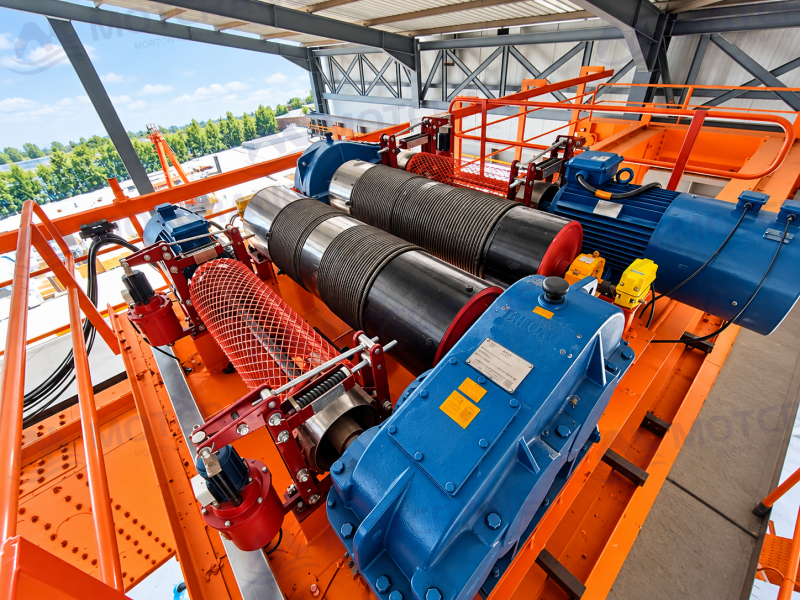
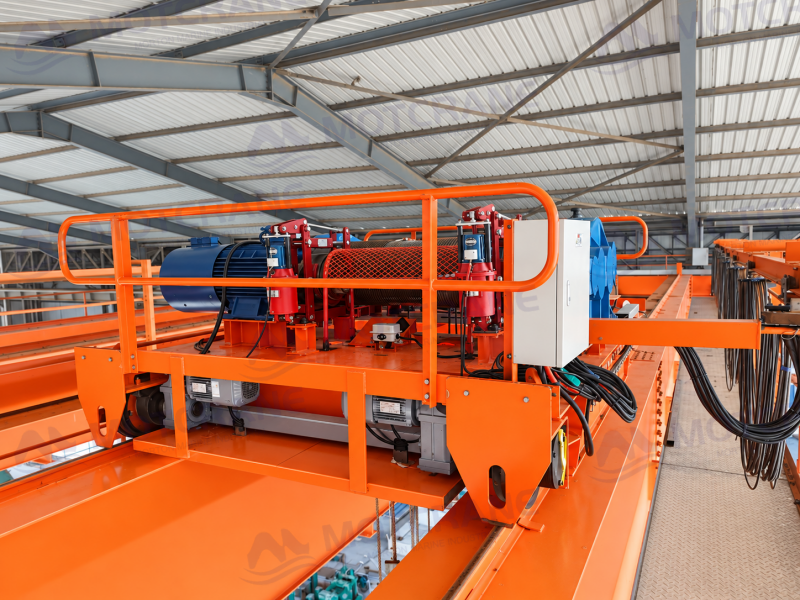
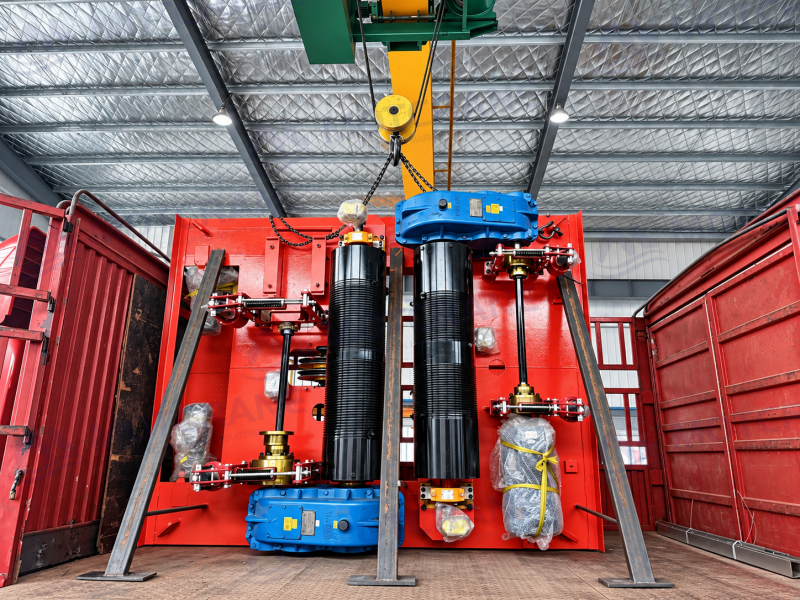
MOTCRANE designed a 10/5 ton open winch trolley to upgrade an existing metallurgical overhead crane in Algeria after the customer’s production requirements changed. The crane needed an additional 5-ton auxiliary hook for lid lifting, with a required hook center-to-center distance of just 750 mm.
The original trolley had no room for a second hoisting mechanism, while two independent trolleys could not meet the specified hook spacing. MOTCRANE redesigned the trolley with integrated main and auxiliary hoists and replaced the electrical control system. Engineering checks also confirmed that the existing crane bridge and travel system could be retained, avoiding replacement of the entire crane.
The customer’s original crane had a single 10-ton main hoist. Following a change in the production process, a 5-ton auxiliary hoist was needed for lid lifting, while the main hoist would continue handling its original tasks.
The main challenge was the required 750 mm center-to-center distance between the two hooks.
The existing trolley frame did not have enough space for an additional hoist, including its drum, drive, and braking components. A separate auxiliary trolley was also ruled out because the two trolleys could not achieve the specified hook spacing within the existing crane arrangement.
The customer therefore needed more than an additional hoist. A new trolley layout and a replacement electrical control system were required.
MOTCRANE designed a new 10/5-ton open winch trolley for the existing double-girder overhead crane, with both hoisting mechanisms mounted on a single frame.
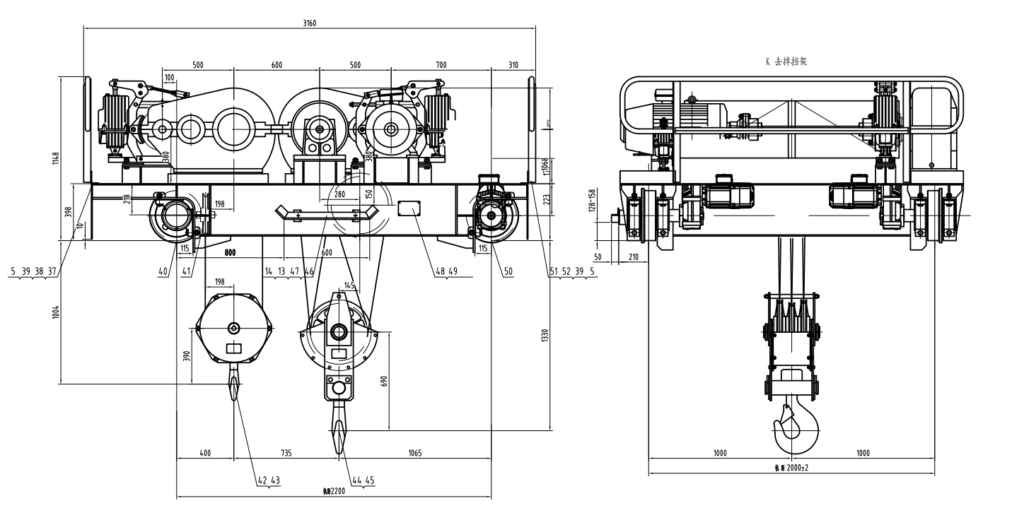
The trolley layout was redesigned to accommodate the drums, drives, brakes, and related components while achieving the required 750 mm hook center-to-center distance. The 10-ton main hook retains its original lifting function, while the 5-ton auxiliary hook handles the new lid-lifting operation.
The original electrical control system was designed for one hoist. It was therefore replaced with a system configured for the new main and auxiliary hoisting arrangement, including the corresponding operating and safety protection requirements.
When the original 10-ton crane was designed, MOTCRANE had already considered the customer’s possible future requirement for a 20-ton lifting capacity. The main girder design therefore included additional load capacity.
For this retrofit, MOTCRANE reviewed the new trolley’s dead weight, wheel loads, and relevant loading conditions. The engineering calculations confirmed that the existing bridge structure and crane travel system could remain in service.
This allowed the upgrade to focus on the new trolley and electrical controls rather than replacing the entire overhead crane.
The upgrade includes:
| Item | Technical Specifications |
| Project Type | Metallurgical overhead crane retrofit |
| Original Crane Capacity | 10 tons |
| New Hoisting Configuration | 10-ton main hook + 5-ton auxiliary hook |
| Hook Center-to-Center Distance | 750 mm |
| Trolley Type | Integrated dual-hoist open winch trolley |
| Main Hoist Application | Existing lifting operations |
| Auxiliary Hoist Application | Lid lifting |
| Electrical Control System | Complete replacement |
| Original Girder Design | Allowance for a possible future 20-ton requirement |
| Structural Verification | New trolley loads and wheel loads checked; existing bridge and crane travel system retained |
| Project Location | Algeria |
Yes, in some cases. However, the decision depends on more than the rated lifting capacity of the original crane.
You need to check whether the existing trolley has room for another hoist, whether the required hook spacing can be achieved, and how a new trolley would affect wheel loads and the crane structure. The bridge, travel system, and electrical controls must also be assessed against the revised operating requirements.
In this Algeria project, the original main girder had been designed with possible future expansion in mind. Combined with the completed structural checks, this allowed the customer to retain the existing crane bridge and travel system.
Planning for future changes does not mean every crane needs to be designed for a higher capacity. It means identifying foreseeable requirements early and deciding whether additional structural capacity or installation space is justified.
If you are considering adding an auxiliary hook or replacing the trolley on an existing overhead crane, send MOTCRANE your original crane drawings, rated capacity, span, duty class, trolley dimensions, and new lifting requirements. We can help you determine which components can be retained and what needs to be redesigned or replaced.



 English
 Russian
 French
 Spanish
 Arabic
 Indonesian
 Japanese