


How Low Headroom Gantry Cranes Solve Indoor Material Handling Challenges in Existing Facilities
When a factory expands production, updates equipment, or upgrades its production line, the available headroom inside the existing facility may no longer meet new lifting requirements. Raising the roof or modifying the steel structure may be possible, but it often brings higher costs, longer construction time, and disruption to normal production.
For many workshops, a low headroom gantry crane is a more practical option. It helps increase the effective hook height without making major changes to the building structure. This makes it useful for indoor material handling in existing facilities where ceiling height, roof beams, pipes, or other obstacles limit the available lifting space.
Instead of rebuilding the workshop, the goal is to make better use of the space that is already available.
Why Existing Facilities Often Lack Sufficient Lifting Space
In older workshops or facilities that have been used for many years, lifting problems are not always caused by the crane itself. Limited headroom, low roof beams, pipes, cable trays, lighting systems, and ventilation equipment can all reduce the actual operating range of the crane and hook.
As equipment is upgraded and production capacity increases, companies may need to handle larger molds, taller equipment, or heavier components. The original lifting system may have worked well in the past, but it may gradually become a limitation as production requirements change.
In many cases, the total building height may look acceptable, but the usable lifting space is still not enough. When evaluating a lifting solution, it is important to check not only the building height, but also the clearance below the beams, on-site obstacles, load size, and actual lifting path.
Why Building Renovation Is Not Always the Best Choice
When an existing facility cannot meet new lifting requirements, many companies first consider building renovation. This may include raising the roof, reinforcing the steel structure, or changing the workshop layout.
However, building renovation usually involves more than the visible construction work. It may also lead to:
- Higher costs for steel structure reinforcement or redesign
- Long construction time for roof removal and reconstruction
- Relocation or reinstallation of production equipment
- Changes to logistics routes and supporting facilities
- More downtime, production interruption, and management work
For companies that need continuous production, these indirect costs can be significant. Before deciding on building modification, it is often worth checking whether the problem can be solved by optimizing the lifting equipment first.
What Is a Low Headroom Gantry Crane?
A low headroom gantry crane is a gantry crane designed for workshops and indoor areas where vertical space is limited. It is commonly used in manufacturing workshops, warehouses, equipment maintenance areas, and facility upgrade projects.
Its value is not simply about increasing lifting capacity. The main purpose is to maximize the effective hook height within the available building space. When a standard gantry crane cannot provide enough hook height, a low headroom crane design can offer a more suitable solution.
This type of crane is especially useful when the workshop itself can still support production, but the existing lifting arrangement no longer provides enough working clearance.
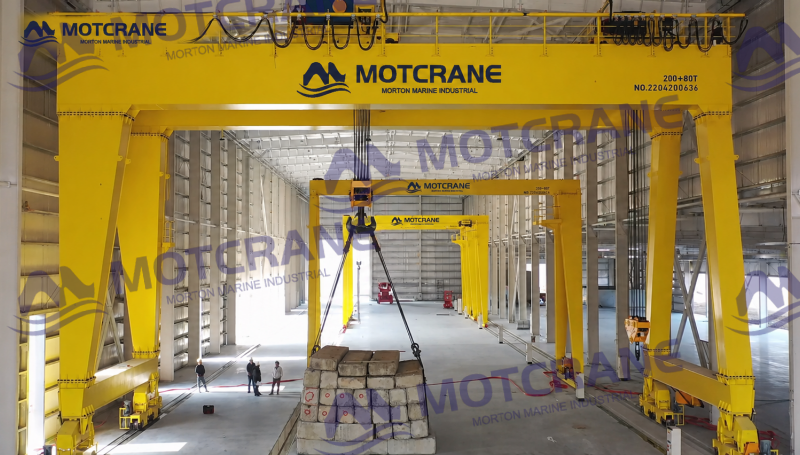
How a Low Headroom Design Increases Effective Hook Height
In a standard gantry crane design, the electric hoist, trolley, and main girder structure occupy part of the vertical space. This reduces the distance between the hook and the floor, especially in workshops with low ceilings or beams.
A low headroom design improves the arrangement of the hoist, trolley, and girder structure to reduce the height occupied by the crane itself. As a result, the hook can reach a higher position even when the building height remains unchanged.
For operations such as equipment installation, mold replacement, large workpiece turning, and maintenance disassembly, this additional hook height can be very important. It may solve a common problem in older workshops: the crane can lift the load, but there is not enough height to position it properly.
Where Low Headroom Gantry Cranes Are Commonly Used
Low headroom gantry cranes are not limited to one industry. They are suitable for many existing facilities where lifting requirements have increased but available space is limited.
1. Older Manufacturing Workshops
Older manufacturing workshops often face new lifting demands after equipment upgrades. Larger workpieces, taller machines, or heavier components may require more hook height than the original lifting system can provide.
In this situation, a low headroom gantry crane can help improve the usability of the existing workshop without requiring major building changes.
2. Equipment Maintenance Workshops
Maintenance workshops often need to remove, lift, and reinstall motors, gearboxes, molds, pumps, and mechanical assemblies. These jobs usually require stable lifting and enough space for positioning.
A low headroom crane can provide more usable lifting height, making maintenance work easier and reducing the difficulty of handling large components.
3. Warehouse Upgrade Projects
When a warehouse introduces automation, multi-level racking, or new material handling equipment, the available indoor space often needs to be used more efficiently.
A low headroom gantry crane can help improve space utilization while supporting new warehouse operating methods.
4. Production Line Expansion Projects
As production lines expand, the existing lifting system may no longer cover the new working area or meet updated handling needs. Optimizing the crane structure can support equipment upgrades, layout changes, and increased production capacity.
5. Temporary or Leased Facilities
For leased workshops or temporary production sites, companies usually care more about return on investment and implementation time. Compared with large-scale facility renovation, a low headroom gantry crane is often easier to install and put into use.
Low Headroom Gantry Crane vs. Building Renovation
When lifting space is not enough, companies often need to choose between building renovation and equipment optimization. In many existing workshops, a low headroom gantry crane can improve lifting capability while making better use of the current space.
| Comparison Factor | Low Headroom Gantry Crane | Building Renovation |
|---|---|---|
| Initial Investment | Lower | Higher |
| Installation Time | Shorter | Longer |
| Impact on Production | Smaller | Greater |
| Project Complexity | Lower | Higher |
| Return on Investment | Faster | Slower |
Before raising the roof or modifying the steel structure, it is usually practical to first check whether a low headroom crane design can meet the lifting requirement.
When Should You Choose a Low Headroom Gantry Crane?
A low headroom gantry crane is suitable when the main problem is not the lifting capacity itself, but the limited usable lifting height inside the facility.
This type of solution is worth considering when:
- The existing workshop has limited headroom
- More effective hook height is required
- New equipment cannot be lifted or installed smoothly
- Large molds, workpieces, or machines are restricted by space
- Major building renovation is not preferred
- Material handling efficiency needs to be improved
- Future equipment upgrades or production line expansion are planned
The common point in these projects is that the workshop can still be used, but the lifting space is not being used efficiently enough.
Of course, a low headroom crane cannot solve every building limitation. If the facility no longer supports long-term production development, or if new large equipment and production areas are planned, building renovation and equipment upgrades should be evaluated together.
What Information Should Be Confirmed Before Selection?
Not every facility needs a low headroom gantry crane. The design should be based on actual site conditions and lifting requirements.
Before preparing a crane solution, the following information should be checked:
- Total building height
- Clearance below the beams
- Lifting capacity
- Required lifting height
- Span requirement
- Load dimensions and center of gravity
- On-site obstacles such as pipes, roof beams, and cable trays
- Workshop photos or layout drawings
- Future expansion plans
The more complete the information is, the easier it is to determine whether a low headroom crane is suitable. It also helps avoid design changes after installation begins.
Common Mistakes When Selecting a Crane for Existing Facilities
Many problems in material handling upgrade projects do not come from technical difficulty. They often come from missing key site details during the early planning stage.
1. Measuring Only the Total Building Height
Some companies only check the overall building height but ignore the clearance below beams, pipes, cable trays, lights, and ventilation equipment. When installation starts, they may find that the actual usable space is much smaller than expected.
For low headroom projects, the real usable height is more important than the total height of the building.
2. Focusing Only on Lifting Capacity
Some projects focus only on tonnage. However, lifting capacity alone does not determine whether the crane will work well.
Load size, lifting path, hook height, workpiece turning space, and installation position also affect daily operation. A crane with the right capacity may still be inconvenient if the lifting space is not properly checked.
3. Ignoring Future Expansion Needs
To control the initial budget, some companies choose equipment based only on current needs. As orders increase or production processes change, the original crane may soon reach its limit.
If future equipment upgrades or production line expansion are already planned, they should be considered during the first design stage.
Key Design and Customization Options
Each facility has different building conditions and lifting requirements. A low headroom gantry crane can usually be customized according to the actual project.
Common customization options include:
- Single girder or double girder structure
- Different hoist configurations
- Manual or electric travel
- Cable power supply or conductor rail power supply
- Custom span
- Custom lifting height
- Custom overall crane height
- Special lifting attachments or auxiliary lifting solutions
Among these options, hoist arrangement and overall crane height are especially important. A well-designed low headroom crane can reduce the height occupied by the crane structure and increase the actual usable hook height.
Frequently Asked Questions
1. How Can I Tell Whether the Problem Comes from the Building or the Crane Design?
Many companies assume that insufficient lifting height is caused by the building height. In some cases, the real issue is the crane design, hoist arrangement, main girder structure, or limited hook travel.
Before deciding on building renovation, it is better to review the existing headroom, crane layout, hoist configuration, and actual lifting process. If the lifting requirement can be met by optimizing the crane structure, a low headroom gantry crane may be the more practical solution.
2. What Information Should I Prepare Before Requesting a Quote?
You should prepare the building height, clearance below beams, lifting capacity, required lifting height, span, load size, and workshop photos or layout drawings.
If there are roof beams, pipes, cable trays, lighting systems, or ventilation equipment inside the workshop, these details should also be included. They may directly affect the final crane design.
3. How Much Additional Hook Height Can a Low Headroom Gantry Crane Provide?
The actual increase in hook height depends on the crane structure, hoist configuration, and site conditions. In general, a low headroom design can provide more usable hook height than a standard configuration, but the exact result needs to be confirmed according to the project.
Summary
For many existing facilities, insufficient lifting space does not always require raising the roof or carrying out large-scale structural modification. With a properly designed low headroom gantry crane, companies can often achieve greater effective hook height within the existing building conditions.
This can improve indoor material handling efficiency, reduce the impact on daily production, and provide a more practical solution for workshops with limited headroom.
If you are planning a low headroom gantry crane project, you can send MOTCRANE your site photos, workshop layout drawings, building height, lifting capacity, and required lifting height. We can help assess the available headroom on site and provide a practical, cost-effective solution based on your project requirements.



 English
  Russian
  French
  Spanish
  Arabic
  Indonesian
  Japanese