


5 Ton Overhead Crane for Workshop Material Handling
Not every workshop requires a high-capacity crane. For many manufacturing workshops, steel fabrication plants, equipment maintenance areas, and some heavy-duty warehouse applications, the workpieces handled on a daily basis are usually within 5 tons.
Compared with larger-capacity overhead cranes, a 5-ton overhead crane is easier to integrate into standard workshop buildings. It also places relatively lower requirements on runway beams, installation space, and overall investment, making it a common and practical solution for workshop material handling.
A 5-ton overhead crane is not only used to “lift 5 tons.” In real workshop operations, it is more often used for frequent and stable internal material transfer. With the right crane structure, lifting height, travel speed, and control method, it can help improve material flow efficiency and reduce dependence on forklifts and manual handling.
For many factories, a properly selected workshop overhead crane is not simply a lifting device. It becomes part of the production flow, helping materials move more smoothly between cutting, machining, welding, assembly, storage, and maintenance areas.
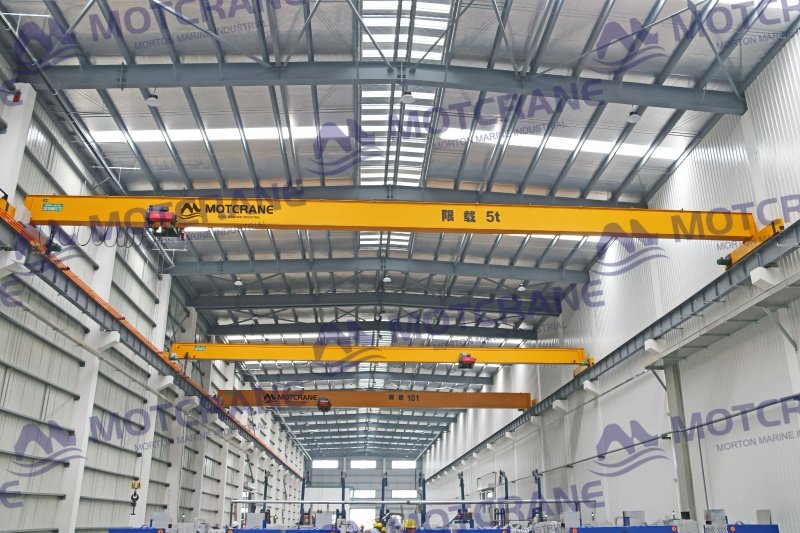
I. Is a 5 Ton Overhead Crane Suitable for Your Workshop?
If your workshop has the following working conditions, a 5-ton overhead crane can usually meet daily lifting and handling requirements:
- Frequent internal material transfer is required within the workshop
- Most individual loads are between 1 and 5 tons
- You want to reduce forklift use and manual handling
- The workshop has conditions for installing crane rails or runway beams
- Stable, safe, and efficient lifting is required
Many factories initially assume that a higher lifting capacity means greater safety. In practice, this is not always the case. Crane selection should be based on actual site conditions, including span, lifting height, frequency of use, workshop structure, and load type.
If most daily lifting loads are within 5 tons, a 5-ton overhead crane is often a more cost-effective and practical choice for long-term use. Choosing a crane that matches the actual working condition is usually more important than simply selecting a larger capacity.
II. Common Applications of a 5 Ton Overhead Crane in Manufacturing Workshops
5-ton overhead cranes are widely used in manufacturing, fabrication, maintenance, and warehouse environments. Although each workshop has different operating requirements, the main purpose is usually the same: improving material handling efficiency while keeping lifting operations stable and safe.
2.1 5 Ton Overhead Crane for Steel Fabrication Workshops
Steel fabrication workshops usually require frequent lifting of steel beams, steel plates, welded components, and structural parts. An overhead crane can cover key working areas such as cutting, welding, and assembly zones, reducing the time spent on ground-level material handling between different workstations.
Common loads include:
- Steel beams
- Steel plates
- Welded components
- Structural steel parts
For steel fabrication workshops, a 5-ton overhead crane can help workers handle material transfer, workpiece turning, and assembly positioning more efficiently. It is especially useful when long steel structures need to be moved between different processing areas.
Compared with forklift handling, an overhead crane for steel fabrication can lift materials from above and move them along the workshop span, reducing ground congestion and improving overall production flow.
2.2 5 Ton Overhead Crane for Machinery Manufacturing Workshops
In machinery manufacturing, many equipment components weigh less than 5 tons but have irregular shapes, making them difficult to move and position with forklifts. A 5-ton overhead crane is commonly used for transferring machined parts, assembling equipment, replacing molds, and handling large components.
Common loads include:
- Mechanical parts
- Molds
- Assemblies
- Equipment components
Compared with forklift handling, an overhead crane lifts from above, making it easier to move workpieces between machines and position them accurately during assembly. This is why a 5-ton overhead crane is often used as an overhead crane for manufacturing workshops where lifting stability and positioning control are important.
2.3 Heavy-Duty Warehousing and Logistics Areas
Some heavy-duty warehouse areas also use overhead cranes for loading and unloading large pallets, mechanical equipment, packaged goods, and heavy cargo. For loads that are not suitable for long-distance forklift transport, an overhead crane can provide more stable lifting within a fixed working area.
Common loads include:
- Heavy pallets
- Packaged equipment
- Large cargo
- Mechanical goods
In warehouse and loading areas, overhead cranes can reduce frequent forklift movement inside the workshop and help keep floor aisles clearer. For fixed material handling areas, a 5 ton bridge crane can be a practical solution when forklifts alone are not efficient enough.
2.4 Maintenance and Repair Workshops
Equipment maintenance workshops often need to disassemble and reinstall motors, pumps, gearboxes, and mechanical assemblies. A 5-ton overhead crane can assist maintenance personnel with lifting, moving, positioning, and reinstalling these components, improving repair efficiency.
Common loads include:
- Motors
- Pumps
- Gearboxes
- Mechanical assemblies
- Maintenance equipment components
For maintenance workshops, the value of an overhead crane is not only its lifting capacity. More importantly, it makes the handling of large components safer, more stable, and easier to control.
III. How Can a 5 Ton Overhead Crane Improve Workshop Efficiency?
Many factories install overhead cranes not because their existing handling methods are completely unable to move the loads, but because those methods have already started to affect production efficiency. Forklifts, manual handling, waiting time, and repeated material transfer can all create hidden costs over time.
3.1 Improving Material Transfer Efficiency Between Workstations
In traditional workshops, material transfer often depends on forklifts or manual coordination. If workstations are far apart, or if forklifts need to wait for clear aisles, move around obstacles, or stop frequently for loading and unloading, the next production process can be delayed.
An overhead crane can cover the main working area and allow operators to move materials directly from one workstation to another. This reduces waiting time between processes. For production lines that require continuous machining, welding, or assembly, the improvement in workflow can be significant.
3.2 Reducing Dependence on Forklifts and Manual Handling
Many older workshops face a common problem: forklift use keeps increasing, while floor aisles become more crowded.
An overhead crane moves the handling path to the upper space of the workshop, reducing pressure on floor-level transportation and keeping aisles clearer. For large workpieces, tasks that previously required several workers can often be completed by one operator using the crane.
This not only reduces labor input but also helps lower safety risks caused by improper manual coordination.
3.3 Making Better Use of Overhead Space
Many factories do not actually lack floor area. The real issue is often inefficient use of ground-level space. An overhead crane uses the space above the workshop and does not occupy floor aisles or production areas.
This is especially useful in machining workshops where equipment is arranged closely together. By moving materials through the overhead space, the crane can help optimize the internal logistics route. For older workshops with limited space, this can be very important.
3.4 Achieving More Stable and Precise Load Positioning
During equipment installation, mold replacement, and mechanical assembly, lifting precision is often more important than lifting capacity.
For example, in mold installation, equipment alignment, and large-component assembly, the key concern is whether the lifting process is stable and whether the load can be positioned conveniently. If a workpiece weighs close to 5 tons and swings too much during lifting, on-site adjustment becomes difficult and time-consuming.
A properly configured 5-ton overhead crane can provide smoother operation and better positioning control during the lifting process.
IV. Selecting the Right Overhead Crane Structure for Different Workshop Conditions
Different workshop conditions require different overhead crane structures. Many problems that appear later in a project are not caused by choosing the wrong lifting capacity, but by selecting a structure that does not match the actual site conditions.
When choosing between a single girder or double girder 5 ton overhead crane, the decision should be based on span, lifting height, working frequency, workshop structure, and future production needs.
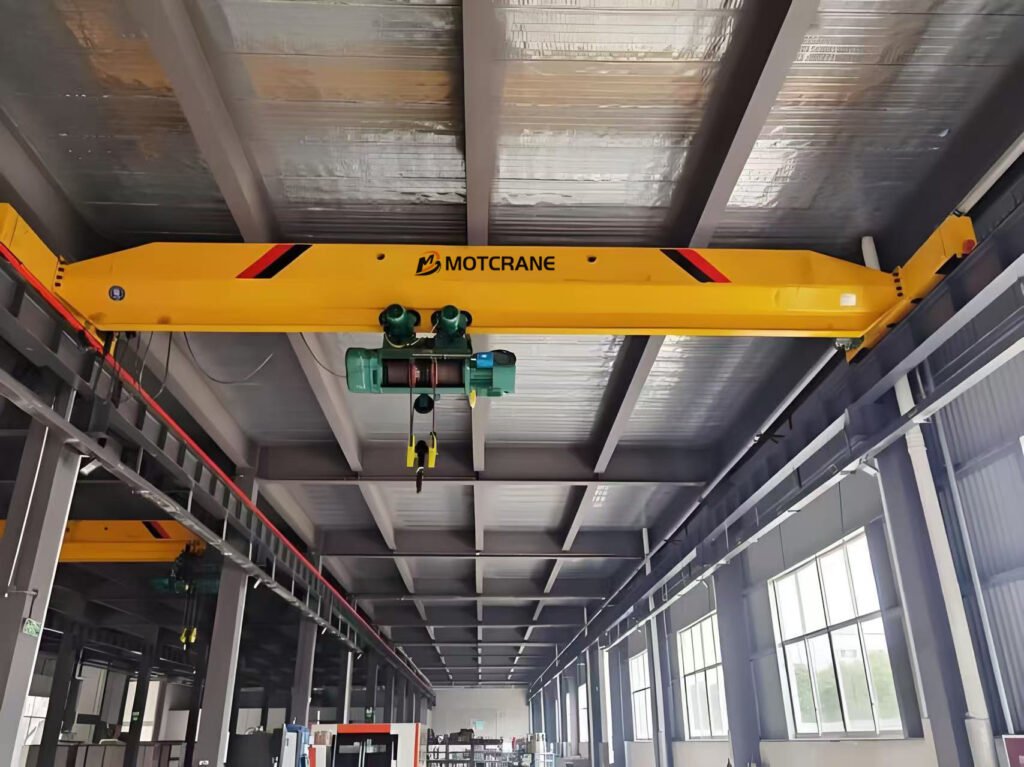
4.1 5 Ton Single Girder Overhead Crane
A 5 ton single girder overhead crane has a relatively simple structure and lighter self-weight, making it suitable for standard manufacturing workshops and medium-frequency lifting operations.
If the workshop span is not large, the lifting height requirement is moderate, and the budget is limited, a single girder overhead crane can usually meet the requirement. For most 5-ton applications, the single girder structure is a common and economical solution.
A 5 ton single girder overhead crane is suitable for:
- Standard manufacturing workshops
- Medium-frequency use
- Workshops with smaller or moderate spans
- Applications with normal lifting height requirements
- Projects with tighter budget control
For many factories, this structure offers a good balance between performance and cost. It is often the first option to consider when the lifting task is not extremely heavy-duty.
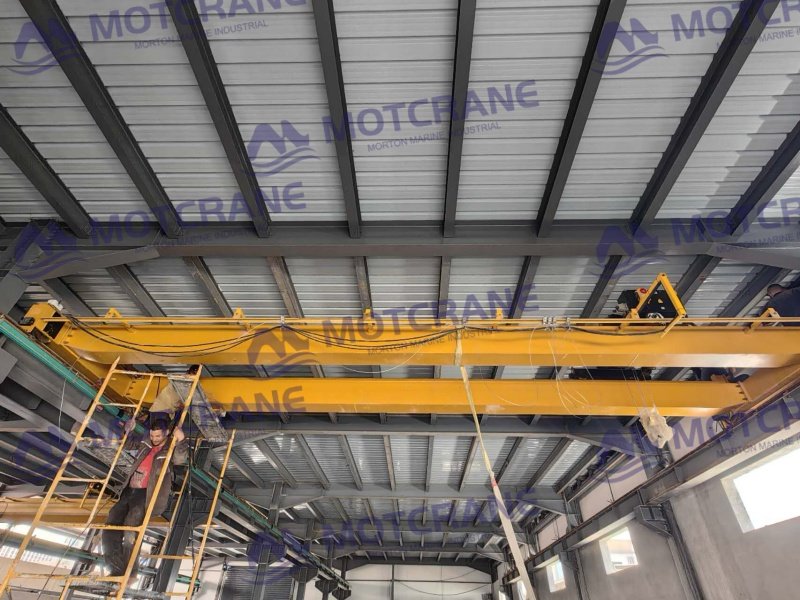
4.2 5 Ton Double Girder Overhead Crane
If lifting operations are frequent, or if greater lifting height is required, a 5 ton double girder overhead crane may be a better choice.
Double girder cranes provide better running stability and are more suitable for long-term continuous operation. Many machinery manufacturing, steel fabrication, and heavy assembly projects prefer double girder structures when the working intensity is higher or future lifting requirements may increase.
A 5 ton double girder overhead crane is suitable for:
- High lifting frequency
- Larger spans
- Higher lifting height requirements
- Higher requirements for operating stability
- Projects that may require more complex lifting tasks in the future
For some workshops, the current load may still be within 5 tons, but the working frequency, lifting height, or production expansion plan may make a double girder structure more suitable in the long term.
4.3 Low Headroom 5 Ton Overhead Crane
Some older factory buildings have limited headroom, and standard crane structures may not provide enough effective hook height.
A low headroom 5 ton overhead crane can increase the available hook lifting height within limited vertical space, making better use of the upper space inside the workshop. This type of solution is commonly used in workshop renovation projects, equipment upgrades, and facilities with restricted headroom.
If the workshop height is limited but you still need to maximize hook height, a low headroom overhead crane should be considered. This is especially important when the load needs to be turned, assembled, or positioned at a certain height.
4.4 Underhung Overhead Cranes
For some light-duty workshops or small to medium-span working areas, an underhung overhead crane can also be an option. This type of crane is usually suspended from the roof structure or load-bearing beams of the building, reducing the need for floor-mounted columns.
This structure is more suitable for workshops with limited floor space or where adding new columns is not convenient. However, before choosing an underhung crane, the roof structure and load-bearing capacity of the building must be carefully checked.
Underhung systems are not suitable for every facility. The final decision should be based on the actual building structure, load-bearing capacity, span, and lifting requirements.
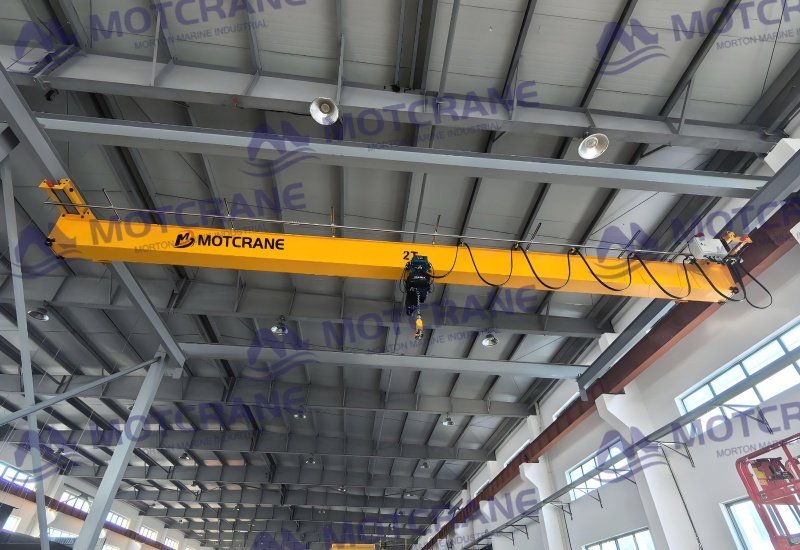
V. How to Choose a 5 Ton Overhead Crane
If you are not sure how to choose a 5 ton overhead crane, the first step is to review the workshop layout, load weight, lifting height, span, duty class, and installation conditions.
When selecting an overhead crane, lifting capacity is only one factor. In many projects, the parameters that are easily overlooked often have a greater impact on long-term performance.
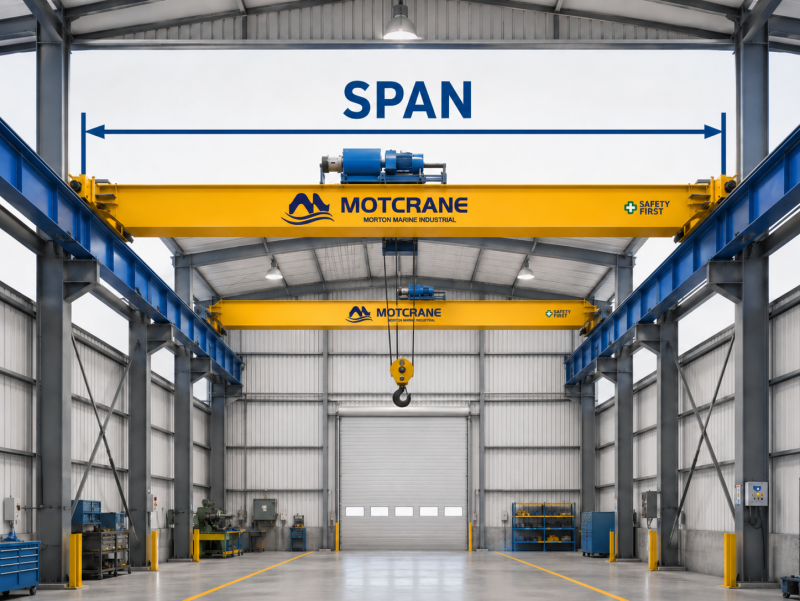
5.1 Span
The span determines the crane’s working coverage. If the span is too small, the crane may not cover the required working area. If the span is too large, it may increase the load on the workshop structure and raise the overall equipment cost.
Before selecting the crane, the span should be confirmed based on the workshop width, workstation layout, and actual lifting range.
5.2 Lifting Height
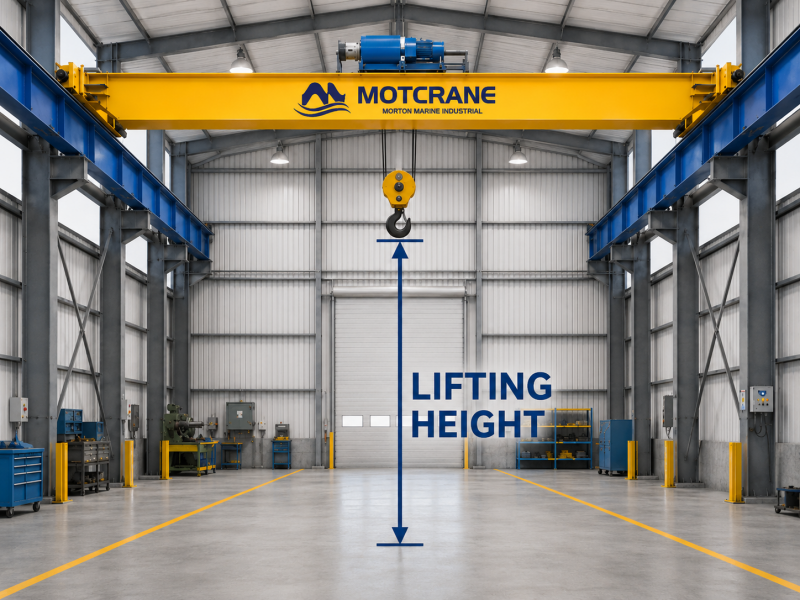
Many customers focus only on lifting capacity at the beginning, but later find that the hook height is not enough for turning, installing, or moving equipment.
Lifting height should be determined based on the workshop headroom, workpiece height, sling length, lifting attachment height, and actual operating clearance.
5.3 Duty Class
Duty class directly affects the motor, gearbox, braking system, and overall service life of the crane. Even for the same 5-ton lifting capacity, the configuration requirements are different for occasional lifting and high-frequency continuous operation.
If the crane will be used frequently, a higher duty class configuration should be considered.
5.4 Installation Conditions
Workshop structure, column spacing, runway beam condition, roof height, and available site space all affect the crane installation plan.
For older workshops or retrofit projects, it is recommended to check the load-bearing condition in advance. This can help avoid installation problems or major structural modifications later.
5.5 Load Type
Different loads have different requirements for lifting attachments and operating stability. Steel coils, molds, long steel beams, and machinery may require different lifting methods or auxiliary lifting tools.
If the load is long, has an irregular center of gravity, or requires accurate positioning, these factors should be considered during the initial selection stage.
5.6 Power Supply and Control Method
For overseas projects, power supply is also an important factor. The crane configuration should match the local voltage, phase, and frequency. Common options may include pendant control, wireless remote control, or cabin control, depending on the working environment and operation requirements.
For most standard workshop applications, wireless remote control is a convenient option because it allows the operator to observe the load movement from a safer and more flexible position.
VI. Common Mistakes When Selecting a 5 Ton Overhead Crane
Many overhead crane problems appear during later use, but the cause often starts during the selection stage.
6.1 Focusing Only on Price
Some users pay too much attention to the initial purchase cost while ignoring long-term maintenance, stability, and service life. A low-configuration crane may be more likely to fail in high-frequency working conditions and may also affect production efficiency.
When selecting an overhead crane, price is important, but it is more important to confirm whether the configuration matches the actual working conditions.
6.2 Ignoring Duty Class
Even for 5-ton overhead cranes, different duty classes can have significant design differences. If a crane is used frequently over the long term but is designed for light-duty operation, its service life may be shortened.
During the selection stage, the proper duty class should be confirmed based on the number of daily operations, operating time, and load conditions.
6.3 Not Fully Considering Headroom
Headroom is one of the most common issues in older factory buildings. If hook height is not fully considered during the early planning stage, it may affect equipment installation, material turning, and actual lifting efficiency later.
For workshops with limited headroom, low headroom structures or other optimized solutions should be considered in advance.
6.4 Not Checking the Workshop Structure
Some customers only provide lifting capacity and span when requesting a quotation, but the workshop structure is just as important. Column spacing, runway beam condition, roof height, building load-bearing capacity, and installation space can all affect the final crane design.
If these conditions are not checked in advance, the project may face installation difficulties or require additional structural reinforcement later.
6.5 Not Considering Future Capacity Expansion
Some factories design the crane strictly according to current working conditions. When production capacity increases later, the existing overhead crane may no longer meet new operating requirements. Upgrading the system later usually costs more and may interrupt production.
Where conditions allow, it is advisable to consider future operating needs and leave some flexibility in the crane configuration.
VII. Custom Overhead Crane Solutions Based on Workshop Requirements
Factory layouts, production processes, and operating rhythms vary from one project to another. For this reason, overhead cranes often need to be adjusted according to actual working conditions.
Common customization options include:
- Non-standard span
- Special lifting height
- Low headroom design
- Variable frequency control
- Wireless remote control
- Explosion-proof configuration
- Double trolley design
- Special lifting attachments
- Outdoor rain protection
- Different voltage standards
- Installation and commissioning support
For some specialized industries, the crane configuration may also need to consider on-site temperature, dust, humidity, and continuous working time. Only after fully understanding the site conditions can a more suitable overhead crane solution be recommended for long-term use.
A custom overhead crane solution is not only about changing dimensions. It should be based on the actual lifting process, workshop layout, working frequency, safety requirements, and installation environment.
VIII. Why Choose MOTCRANE?
MOTCRANE focuses on industrial lifting equipment and customized lifting solutions. Based on different workshop conditions, we can help provide overhead crane configurations that are more suitable for actual use.
From initial selection and engineering design to installation support, MOTCRANE pays attention to the long-term stable operation of the equipment under real working conditions, rather than simply matching basic technical parameters.
For overseas projects, MOTCRANE can also adjust the crane solution according to local voltage standards, workshop structure, operating habits, and installation conditions, helping customers reduce potential problems during installation, operation, and maintenance.
Whether you need a 5 ton bridge crane for a standard manufacturing workshop, a low headroom overhead crane for an older facility, or a custom workshop overhead crane for a specific production process, MOTCRANE can help review the project requirements and recommend a more suitable configuration.
IX. FAQ About 5 Ton Overhead Cranes
1. Is a 5 ton overhead crane enough for a workshop?
Yes, if most of your loads are between 1 and 5 tons, a 5-ton overhead crane can usually meet daily workshop handling requirements. However, span, lifting height, duty class, and installation conditions should also be checked before selecting the crane.
2. Should I choose a single girder or double girder 5 ton overhead crane?
A 5 ton single girder overhead crane is usually suitable for standard material handling and medium-frequency use. A 5 ton double girder overhead crane is more suitable for higher lifting frequency, larger spans, higher lifting height, or more demanding operating conditions.
3. What information is needed before quoting a 5 ton overhead crane?
Basic information usually includes lifting capacity, span, lifting height, runway length, power supply, working frequency, load type, and workshop drawings or photos. These details help determine whether the crane structure matches the actual site conditions.
4. Can a 5 ton overhead crane be customized for low headroom workshops?
Yes. A low headroom 5 ton overhead crane can be designed to improve the available hook height in workshops with limited vertical space. This is common in older factory buildings or renovation projects.
5. Can MOTCRANE supply 5 ton overhead cranes for overseas projects?
Yes. MOTCRANE can provide overhead crane solutions for overseas projects and adjust the configuration according to local voltage standards, workshop structure, installation conditions, and actual lifting requirements.
X. Final Thoughts
When selecting an overhead crane, many workshops first focus on lifting capacity and price. However, the factors that truly affect long-term use are often span, headroom, frequency of use, duty class, workshop structure, and on-site installation conditions.
If the overhead crane solution does not match the actual workshop conditions, it may lead to inconvenient lifting, low operating efficiency, or even limitations in future production.
If you are planning a 5 ton bridge crane or workshop overhead crane project, you can send MOTCRANE your workshop photos, layout drawings, span, lifting height, and basic working conditions. We can help review the installation environment and recommend a more suitable overhead crane solution based on your actual requirements.



 English
  Russian
  French
  Spanish
  Arabic
  Indonesian
  Japanese