


How to Determine Lifting Height for a Freestanding Overhead Crane
Freestanding overhead crane lifting height cannot be defined by a single number; giving your supplier only “6m” can lead to repeated drawing revisions or a crane layout that does not match your actual lifting requirements.In real projects, the problem is usually the measurement reference: you, the supplier, and the drawing may be using different definitions for lifting height, hook height, and headroom.
To avoid this, start with your lifting process and the vertical limits of your workshop. First confirm where the hook must reach, how high the crane may occupy the building, and whether any lifting position is below floor level. Your supplier can then determine the support-column height, runway elevation, crane arrangement, and required hoist travel.
Manufacturers do not always use “lifting height” in exactly the same way. To avoid misunderstanding, specify your highest hook position, lowest hook position, and required hook travel separately when requesting a quotation or reviewing a drawing.
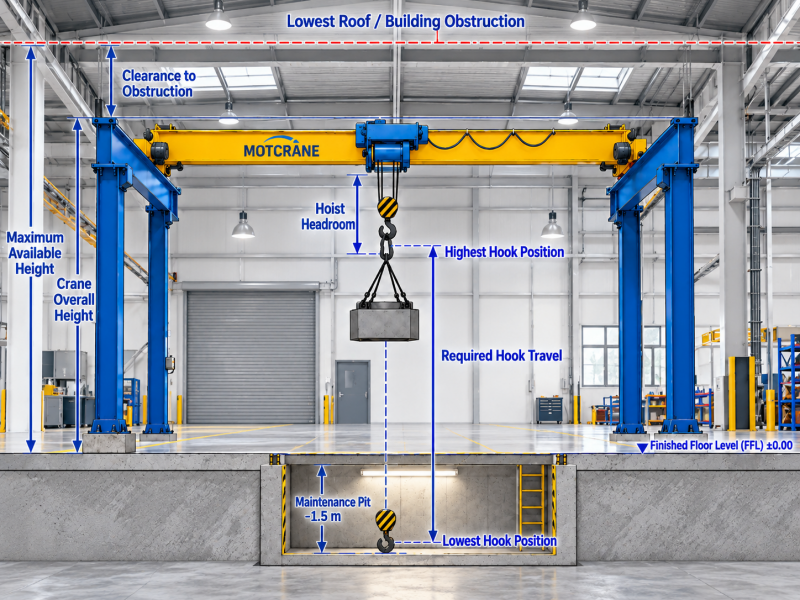
1. Use One Vertical Reference
Use one datum for all vertical dimensions. For most workshops, the Finished Floor Level (FFL) is the simplest reference and can be treated as elevation 0.00.
- your lowest required hook position;
- your highest required hook position;
- the lowest roof, beam, brace, pipe, duct, light, cable tray, or other obstruction above the crane travel area.
Instead of writing only “lifting height = 6m,” give the actual limits. For example: “Maximum allowable crane elevation: 7.5m above FFL; lowest hook position: 1.2m below FFL.” This gives your supplier dimensions that can be used directly in the layout.
The important point is to define every height by where it starts and where it ends.
2. Determine Freestanding Overhead Crane Lifting Height from Hook Positions
Your lowest hook position depends on the pickup point. If you lift from the floor, the hook may need to approach floor level. If you lift from a truck bed or worktable, the lowest position may be higher. If you need to reach a maintenance pit or underground equipment area, the hook may need to travel below FFL.
To determine your highest hook position, include more than the height of the machine or obstacle. You also need the load height, rigging or lifting-device height, and the clearance required above the obstacle.
- Machine height: 3.8m
- Required clearance: 0.3m
- Load height: 1.2m
- Rigging and lifting-device height: 0.6m
Required upper hook position ≈ 3.8 + 0.3 + 1.2 + 0.6 = 5.9m
This is why a 3.8m machine does not mean that a 3.8m hook height is sufficient.
Required Hook Travel = Highest Required Hook Position − Lowest Required Hook Position
If your highest hook position is +6.5m and your lowest is +0.5m, you need about 6.0m of hook travel. If the same hook must descend into a pit at −1.5m, the required travel becomes about 8.0m.
In that case, you do not automatically need a taller crane. If your upper hook position already works, first check whether the hoist provides enough rope or chain travel.
3. Check the Real Height Limit in Your Workshop
Do not rely only on the nominal roof height. You need to inspect the full crane travel area.
Your workshop may have a 9m roof, but a roof brace, duct, lighting fixture, sprinkler pipe, or cable tray may reduce the usable height to 7.6m. In that case, 7.6m—not 9m—is the relevant design limit.
If your crane runs along a 30m runway length, check the complete 30m path. One local obstruction can determine the maximum crane elevation. For a freestanding overhead crane, this limit directly affects the support-column height, runway elevation, bridge arrangement, and highest achievable hook position.
4. Understand How Headroom Affects Your Hook Height
Even after you know the maximum height available in your workshop, you cannot use all of it as hook height. The hoist, trolley, bridge girder, runway structure, and required clearances occupy space above the hook.
You normally do not need to calculate this headroom yourself. Once you provide the site limit and required hook positions, your supplier should select the column height, runway elevation, girder arrangement, and hoist configuration that fit the available space.
If a standard arrangement cannot give you the upper hook position you need, then a low-headroom hoist or a more compact layout can be considered. You should not start by specifying a low-headroom crane unless your site actually requires one.
5. Match the Solution to the Actual Height Problem
Once you know your hook range and workshop limit, identify what actually needs to change:
- If you still have unused space above the crane, increase the support-column height or runway elevation where practical.
- If the crane is already as high as your building allows but the hook still cannot reach the required upper position, optimize the hoist or bridge arrangement.
- If the upper hook position is acceptable but the hook cannot descend far enough into a pit or lower work area, check the hoist travel first.
Separating these situations helps you avoid unnecessary structural changes and makes quotations from different suppliers easier to compare.
6. Confirm Everything on the GA Drawing
Before manufacturing starts, use the General Arrangement (GA) Drawing as the final dimensional reference. Do not approve the crane based only on a single “lifting height” value.
When you review the drawing, confirm that it clearly shows:
- your highest and lowest required hook positions;
- the effective hook travel;
- the runway or rail elevation and overall crane height;
- the clearance to the lowest overhead obstruction;
- any below-floor lifting requirement.
The GA drawing should prove two things before you approve it: the hook can complete your actual lifting process, and the complete crane can fit within the vertical space available in your workshop.
Conclusion
Freestanding overhead crane lifting height, hook height, and headroom should be treated as one vertical design system rather than as isolated specifications.
The most useful information you can provide is your workshop’s maximum usable height, your highest and lowest required hook positions, and the dimensions of the load and rigging. MOTCRANE uses these site conditions to determine the appropriate support-column height, runway elevation, crane arrangement, and hoist travel, rather than relying on a single lifting-height value.
If you are planning a freestanding overhead crane, send us your workshop layout or key dimensions. MOTCRANE can review the available clearance and lifting requirements and prepare a practical crane layout for your application before production.



 English
  Russian
  French
  Spanish
  Arabic
  Indonesian
  Japanese