


Workstation Bridge Crane vs. Overhead Crane: Which Is Right for Your Application?
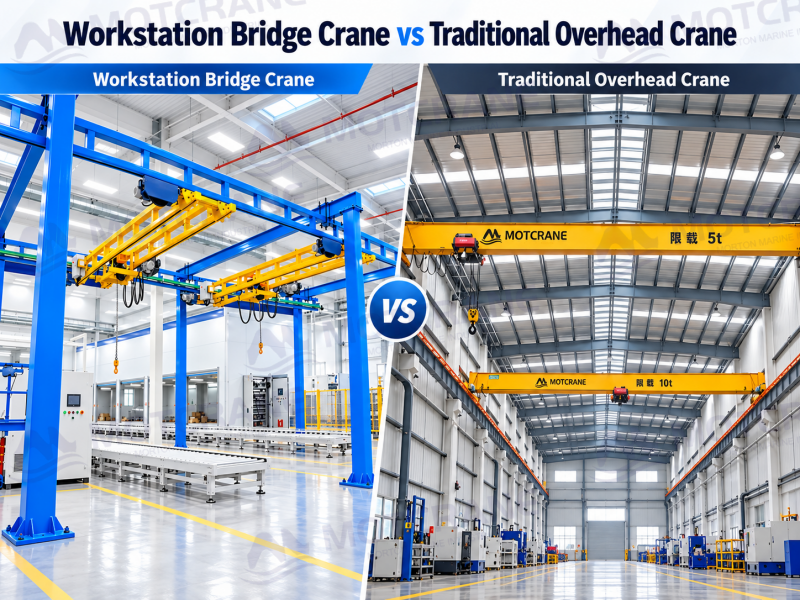
If you only need to frequently move and position workpieces within an assembly station, machining area, or local production unit, you should generally consider a workstation bridge crane first; if cargo needs to be moved continuously across a large workshop area, or if heavier or larger components are involved, a traditional overhead crane is often more suitable.
The term “traditional overhead crane” used in this article refers to standard workshop bridge cranes; the workstation bridge crane is also a type of bridge crane system. Both can be powered by electric drives and may feature independent support structures, so you cannot base your decision solely on lifting capacity, travel mode, or support configuration.
1. First, determine the locations the hook needs to cover
You should first mark each pick-up and drop-off point on the factory floor plan to confirm the required span, travel length, and actual coverage area of the hook, rather than selecting equipment based solely on the overall length and width of the facility.
If cargo moves only within a single assembly cell or between a few adjacent pieces of equipment, a workstation bridge crane is easier to configure around the local work area. If the same hook needs to serve multiple areas continuously along a long production line, a traditional overhead crane should be evaluated first. If movement occurs only along a fixed route, you may also consider a Workstation Monorail instead of necessarily using a bridge structure.
2. Verify Load, Lifting Attachments, and Workpiece Dimensions
You need to provide the maximum workpiece weight, dimensions, center of gravity, lifting points, and the weight of the lifting attachments. The rated lifting capacity must meet the actual lifting configuration. For long or eccentric workpieces, or those requiring rotation, you must also verify that the lifting attachments are compatible with the available operating space.
Based on MOTCRANE’s current product range, aluminum alloy Workstation Cranes have a maximum capacity of 2 metric tons, while steel models have a maximum capacity of 3 metric tons; these must be confirmed through calculations considering span and structure. Free-Standing Bridge Cranes are typically recommended starting at 3 metric tons or higher. Therefore, 3 metric tons represents a crossover point where solutions must be compared based on specific operating conditions, rather than an absolute cutoff.
For example, for a 1-metric-ton load positioned within a 5 m × 8 m assembly area versus a long component transported 40 m across the shop floor, the same layout cannot be selected based solely on weight.
3. Evaluate Lifting Frequency and Simultaneous Operations
You need to track the number of lifting operations per shift, the pickup and drop-off locations for each operation, whether there are any waiting periods, and whether multiple workstations must use lifting equipment simultaneously. High-frequency, short-distance assembly or machine tool loading/unloading typically calls for configuring a workstation crane around the workstations; continuous material transport across zones is better suited for evaluating the operating routes of a workshop-level overhead crane.
In particular, confirm whether parallel lifting is required: even if a single large overhead crane covers all workstations in the layout, it may not necessarily meet the cycle times required for simultaneous operations at multiple workstations.
4. Determine Whether Manual or Electric Operation Is More Appropriate
If your operators frequently need to make short-distance, fine adjustments to the hook position, prioritize evaluating lightweight rail and manually operated solutions, and verify the actual pushing and pulling forces.
If travel distances are long, loads are heavy, or manual operation affects efficiency, motorized bridge or trolley travel may be more practical. Workstation Bridge Cranes are also available in electric configurations; therefore, whether the crane is electric should not be the sole criterion for distinguishing between the two types of cranes. The drive method should be determined based on travel distance, operating cycle, and positioning requirements.
5. Check Building Structure and Support Requirements
You need to verify the available headroom, the building’s load-bearing capacity, column locations, floor and foundation conditions, and check for obstacles such as pipes, light fixtures, and equipment along the crane path.
A workstation bridge crane can be suspended from the building structure or mounted on independent columns. If a traditional overhead crane is not suitable for use with the existing building’s track-supporting structure, it can be configured with independent steel columns and track-supporting beams, resulting in a free-standing bridge crane.
The key to a Free-Standing Bridge Crane is to transfer the lifting load to the foundation via an independent support structure, rather than simply “adding a traveling mechanism” to a standard bridge crane. Independent support also requires calculating column reaction forces, floor or foundation conditions, and anchoring requirements; civil engineering calculations must not be overlooked simply because the system does not rely on the building structure.
6. Compare Total Project Costs for Identical Tasks
You cannot simply compare quotes for the equipment itself. You must also factor in columns, tracks, foundations, electrical work, installation, the impact of production downtime, and long-term maintenance.
When a single workstation crane can handle a specific workstation, there is no need to install tracks across the entire span of the workshop. However, if there are multiple adjacent workstations, you cannot simply compare the price of “three workstation cranes” to that of “one traditional overhead crane.”
You should first confirm whether these workstations require simultaneous lifting operations, then compare equivalent solutions: multiple sets of standalone workstation equipment, multiple bridge cranes on a shared track, or a combination of workstation equipment and a shop-wide bridge crane. When using a shared track, you must also verify combined loads and operational interference. Only by comparing total costs under the premise that coverage, simultaneous operation capacity, and production cycle times are comparable will the conclusion be meaningful for procurement decisions.
Workstation Bridge Crane vs Overhead Crane: Quick Assessment
| Your Actual Needs | Priority Solution |
| Local assembly, machine tool loading/unloading, repeated positioning | Workstation Bridge Crane |
| Continuous coverage of a large area, long-distance transport | Traditional Overhead Crane |
| Lightweight aluminum alloy solution (up to 2 metric tons) | Aluminum Workstation Crane |
| Steel workstation solution (up to 3 metric tons, requires calculation) | Steel Workstation Crane |
| Approximately 3 metric tons, with a large span or operating range | Compare Steel Workstation Crane with Traditional Overhead Crane |
| Requires an electric hoist or trolley | Both types offer electric options; select according to load, travel distance, and operating requirements. |
| Existing factory building cannot support track loads | Compare two types of self-supporting solutions |
| Multiple workstations require simultaneous lifting | Solutions involving multiple units or shared tracks with multiple overhead cranes |
When Should You Consider a Combined Solution?
If you require both frequent positioning within workstations and cross-area transport, you can assign the Workstation Crane to handle local operations and the traditional Overhead Crane to handle shop logistics. Whether to combine the two and how many units are needed should be determined based on lifting routes and simultaneous operation requirements.
Conclusion
You should first narrow down your options based on coverage and operational workflows, then validate the solution using load capacity, drive type, structural conditions, and total cost. Do not rely solely on factors such as a 3-metric-ton capacity, electric travel, or freestanding support as the sole criteria for decision-making.
If you are comparing two solutions, please provide MOTCRANE with the workpiece weight and dimensions, lifting paths, lifting height, number of operations per shift, number of workstations requiring simultaneous operation, and workshop floor plans. Based on this information, we can compare workstation crane systems, traditional overhead cranes, and freestanding support solutions to help you determine the appropriate number of units and layout before we provide a quote.



 English
  Russian
  French
  Spanish
  Arabic
  Indonesian
  Japanese