


How to Determine the Required Lifting Height for a Hydraulic Gantry Crane System
When planning a lift with a hydraulic gantry crane system, the harder question is often how high the load must travel and how that requirement should be converted into gantry working height and lifting stroke.
A hydraulic gantry lifts through a beam and rigging connected to designated lifting points, so you should not estimate lifting height from the equipment’s overall height alone. To determine the required lifting height for a hydraulic gantry crane, you first need to identify the initial and final lifting-point elevations, the highest position required along the lifting path, and the available overhead clearance.
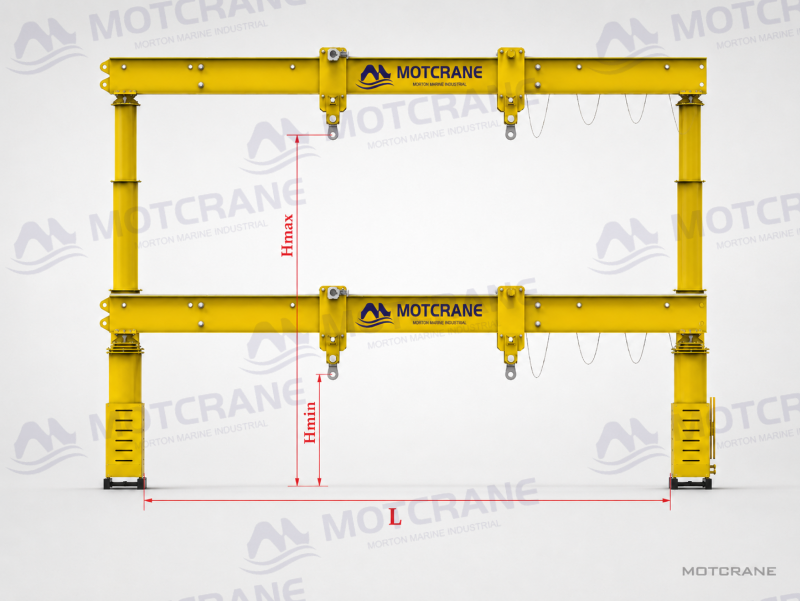
Required Lifting Height for a Hydraulic Gantry Crane: 5 Key Values to Distinguish
| Parameter | What It Means |
| Overall Equipment Height | The external equipment height, mainly used for space and clearance checks. |
| Initial and Final Lifting-Point Elevations | The lifting-point elevations before lifting and at the final installed position. |
| Preliminary Vertical Lifting Distance | The vertical displacement between the initial and final lifting-point elevations. |
| Highest Required Lifting-Point Elevation | The highest position reached during lifting, travel, positioning, and set-down. |
| Hydraulic Gantry Operating Range | The minimum/retracted working height, maximum lifting height, and available lifting stroke. |
1. Determine the Final Position the Equipment Must Reach
Confirm where the equipment will finally be installed, using a precise elevation reference whenever possible.
For example, the bottom surface of your equipment may need to be installed 3.0 meters above the current ground level. This establishes the final installation reference, but it does not directly determine gantry lifting height because the gantry acts on the lifting points, not the equipment base.
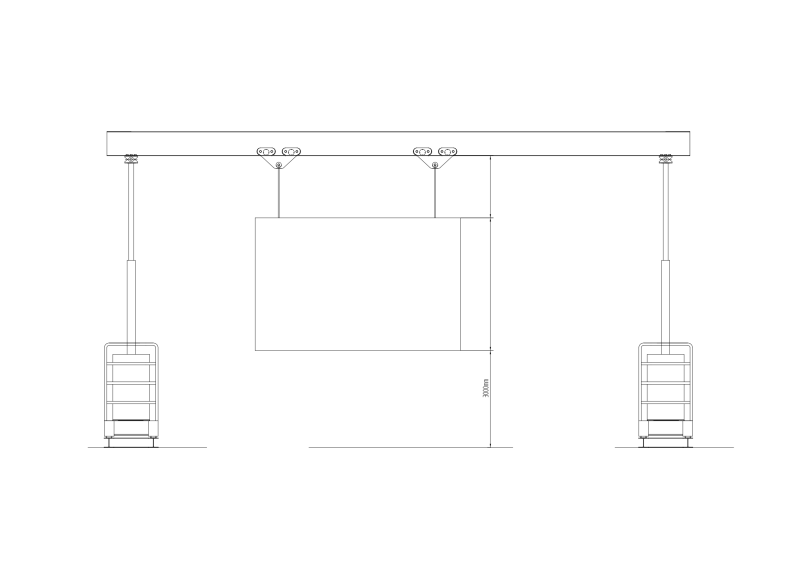
2. Identify the Actual Lifting Points on the Equipment
Using drawings or an on-site inspection, identify the designated lifting points.
You should confirm the elevation and position of each lifting point, the equipment’s center of gravity, and whether multiple lifting points will be used.
If the equipment is 3.0 meters high but the current lifting-point elevation is only 0.8 meters, the calculation should use 0.8 meters rather than the total equipment height.
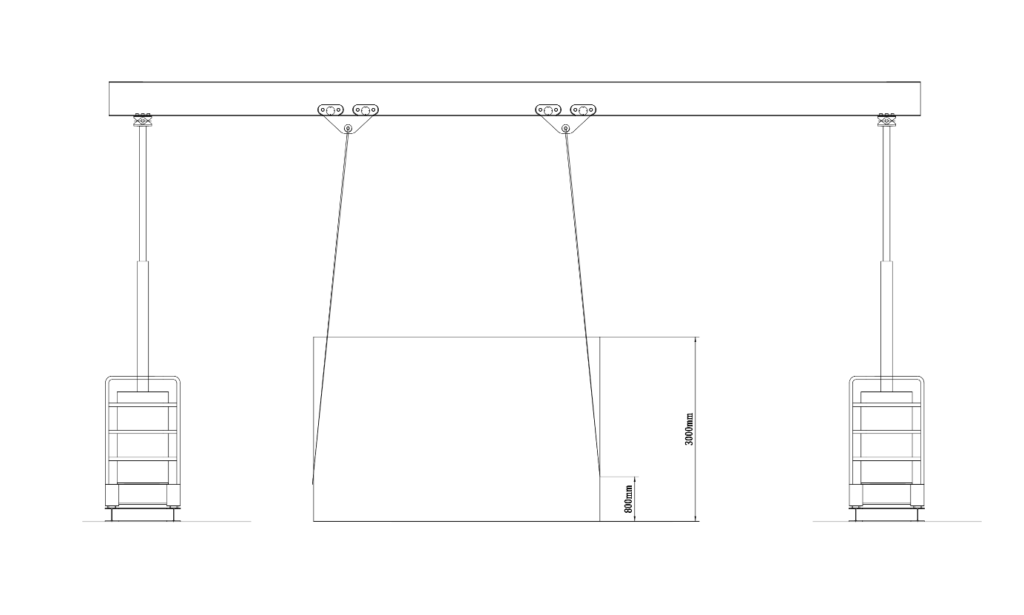
3. Determine the Final Elevation of the Lifting Points
Next, determine where those same lifting points will be after the equipment reaches its final installed position.
Assume the equipment base will be installed 3.0 meters above ground, the lifting points are 0.8 meters above the equipment base, and the equipment remains in the same orientation during the lift.
Final lifting-point elevation = 3.0 m + 0.8 m = 3.8 m
There is no standard allowance for every project. The final lifting-point elevation depends on equipment geometry, lifting-point location, rigging arrangement, and final installation orientation.
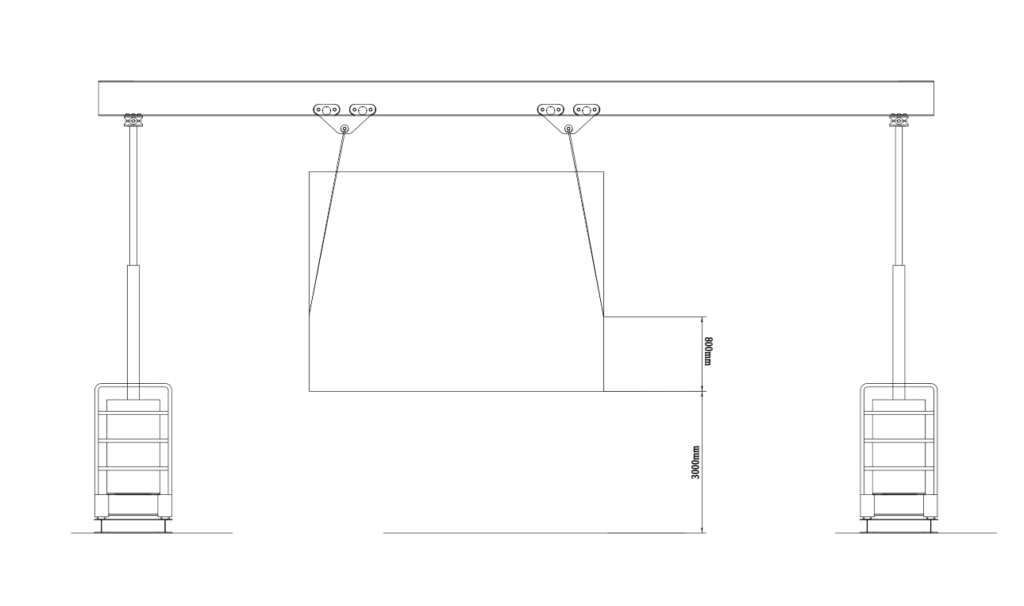
4. Calculate the Preliminary Vertical Lifting Distance
Once the initial and final lifting-point elevations are known:
Preliminary vertical lifting distance ≈ Final lifting-point elevation − Initial lifting-point elevation
Using the example above:
3.8 m − 0.8 m = 3.0 m
The lifting points therefore need to move upward by approximately 3.0 meters.
This does not mean the hydraulic cylinder stroke must be 3.0 meters, nor is it enough to select the final gantry height or model. The gantry structure, telescopic stages, lifting beam, trolley, rigging, working range, and complete lifting path must still be considered.
5. Check Whether the Lifting Path Requires a Higher Position
The final installation elevation is not always the highest point reached during the lift. Your load may need to clear a foundation edge or surrounding structure, align with the installation position, enter a restricted area, or rise above the final level before being lowered.
Determine the highest elevation the lifting points must reach during the complete lift, travel, positioning, and set-down process. If any part of the path is higher than the final installation position, that point becomes critical for the required gantry working range.
If horizontal travel is required, do not assume the load must first be raised to maximum height. The travel elevation should only be high enough to clear obstacles and follow the approved procedure. Whether loaded travel is permitted, and at what height, should be confirmed from the gantry design, load condition, travel system, and project procedure.
6. Check Available Clearance Using the Lowest Overhead Obstruction
Once you know the highest required lifting position, check whether your site has enough clearance.
Do not rely only on the building height. Identify the lowest obstruction above the lifting path, such as roof beams, pipes, cable trays, lighting, or ventilation equipment.
For example, if the building is 8.0 meters high but the lowest steel beam above the lifting area is only 6.5 meters high, evaluate available overhead clearance using 6.5 meters.
Also check the complete lifting envelope, including the load, rigging, lifting beam, trolley, and gantry structure. A project requiring 3.0 meters of vertical load travel does not necessarily require only 3.0 meters of additional overhead space.
7. Convert the Project Requirement into Hydraulic Gantry Operating Parameters
Once the required vertical working range is clear, convert it into the parameters needed for hydraulic gantry selection.
Before selecting a model, you should confirm:
- minimum overall gantry height at the start of the lift;
- maximum overall height required at the highest lifting position;
- effective lifting stroke and telescopic stages;
- space occupied by the main girder, trolley, rigging, and connections;
- clearance to overhead obstructions at the highest position;
- rated lifting capacity at the required working height or telescopic stage.
Reaching the required height is not enough. For a telescopic hydraulic gantry, verify that capacity at the required extension stage is sufficient for the actual load and load distribution. For additional safety requirements, refer to ASME B30.1.
Special Lifting Conditions: What Changes in the Height Calculation?
A simple height-difference calculation works best when the load remains stable and the lifting path is straightforward. More complex projects require additional checks.
Multiple Lifting Points
Confirm each lifting-point elevation, center of gravity, load distribution, and whether all points must rise at the same rate. Multi-point lifting may require synchronized control or a lifting beam.
For a practical example, see our 30+30 ton hydraulic gantry system for pressure vessel lifting in Russia, where four lifting points were used for synchronized lifting.
Load Tilting or Rotation
If the equipment must tilt or rotate, lifting-point elevations change with orientation. Review several stages of the lifting path, including center of gravity, rigging geometry, and the highest position reached.
Large Lifting Beams or Spreader Beams
Include beam depth, trolley position, rigging length, and connection arrangement when checking gantry height and headroom. In low-headroom projects, the beam and rigging arrangement may need optimization.
Restricted Overhead Clearance
When headroom is limited, work backward from the lowest obstruction. Account for the gantry structure, trolley, lifting beam, rigging, and load. If space is insufficient, the lifting arrangement may need to change rather than simply selecting a larger gantry.
Loaded Travel
If the load must move horizontally, confirm the required travel elevation. Check obstacle clearance, load stability, center of gravity, travel-path conditions, load distribution, and permitted capacity at that height. Raise the load only as high as needed to clear obstacles.
Confined Final Installation Areas
Confirm how the load will enter the final position, available clearance, whether lateral positioning is required, and whether the gantry can remain in position during set-down. Depending on the project, track travel, side shift, staged positioning, or special lifting beams may be required.
Which Information Is Essential for a Complex Hydraulic Gantry Project?
Before finalizing a complex gantry configuration, you should normally provide:
- load weight and dimensions;
- center of gravity;
- lifting-point locations and elevations;
- highest required lifting-point elevation;
- lifting and travel path;
- rigging and lifting-beam arrangement;
- available overhead clearance;
- floor or track conditions.
Functions such as synchronized lifting, side shift, loaded travel, or special lifting beams should be selected only when required.
If You Are Still Unsure About the Required Lifting Height
Organize your project data in this order:
Current lifting-point elevation → Final lifting-point elevation → Preliminary vertical lifting distance → Highest required lifting-point elevation → Lowest available overhead clearance → Required hydraulic gantry operating range
For a straightforward lift, this provides a reasonable preliminary height requirement. For restricted headroom, multiple lifting points, load tilting, loaded travel, special rigging, or a complex path, a single “lifting height” figure is not sufficient.
Provide MOTCRANE with equipment drawings, weight and dimensions, lifting-point locations, initial and final elevations, lifting path, and site-clearance information. We can use these details to determine the required lifting range and select a hydraulic gantry configuration that matches the actual lifting procedure.
Summary
The required lifting height for a hydraulic gantry crane is not determined by equipment height alone. You need to identify where the lifting points start and finish, the highest position reached along the lifting path, the available overhead clearance, and whether the gantry can provide the required height and lifting capacity at that stage.
For a simple vertical lift, the difference between the initial and final lifting-point elevations gives a useful preliminary lifting distance. For complex paths, restricted headroom, multiple lifting points, load tilting, or loaded travel, the final gantry parameters should be confirmed through a complete engineering review.



 English
  Russian
  French
  Spanish
  Arabic
  Indonesian
  Japanese