


Fixed Height vs Adjustable Height Aluminum Gantry Crane: Which Should You Choose?
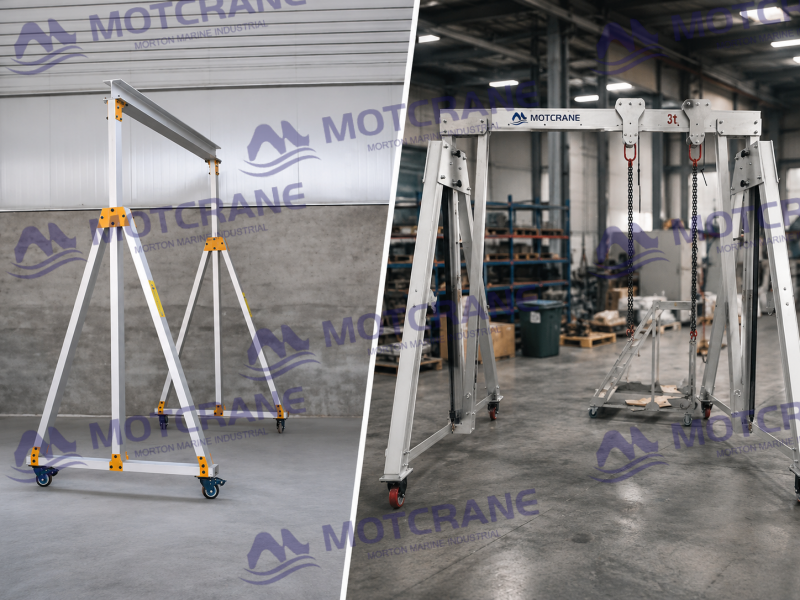
Once you have decided to use an aluminum gantry crane, the next question is whether you actually need an adjustable-height design.
If the crane will remain at one workstation and the required hook height stays largely the same, a fixed-height configuration is often enough. If the same crane needs to work with equipment at different heights or move between areas with different headroom, adjustable height can be more useful.
This fixed height vs adjustable height aluminum gantry crane comparison is not about which design is more advanced. It is about which one better fits your workflow.
Fixed Height vs Adjustable Height Aluminum Gantry Crane: Quick Comparison
| Decision Factor | Fixed Height | Adjustable Height |
| Height | Required crane height remains stable | Required crane height changes between tasks or work areas |
| Area of Use | Long-term use at the same workstation | Serves several workstations or equipment with different height requirements |
| Structure | Simpler fixed-leg structure | Adjustable leg structure with locking and height-adjustment components |
| Adjustment | No height adjustment during normal use | Adjusted unloaded, then locked and checked before lifting |
| Future Changes | Production layout is relatively stable | Equipment or workstation layout may change |
| Cost | Usually lower when the required height is already known | Usually higher because of the additional adjustable structure and components |
| Main Benefit | Simple operation with fewer adjustment steps | Greater flexibility for different working heights |
What Do “Fixed Height” and “Adjustable Height” Mean?
A fixed-height aluminum gantry crane is built to a predetermined crane height. The height is not normally changed during use.
“Fixed height” does not mean that the crane is permanently fixed to the floor. If suitable casters are provided, the crane can still be moved within its approved working area.
An adjustable-height aluminum gantry crane allows the overall crane height to be changed within an approved design range.
For the aluminum gantry cranes discussed here, the span is fixed once the crane is designed and manufactured. Adjustable height does not mean that the span or other structural dimensions can also be adjusted on site.
All height adjustments must be carried out with the crane completely unloaded and on a stable, level surface. After adjustment, the locking pins and connecting components must be fully secured and checked before lifting resumes.
For broader guidance on the construction, operation, inspection, testing, and maintenance of portable gantry cranes, refer to ASME B30.17.
Will Your Lifting Conditions Change?
If you are lifting motors, pumps, or mechanical components at the same maintenance station, and the lifting position and required hook height remain largely unchanged, a fixed-height crane is normally sufficient.
Once the dimensions are confirmed, there is no need to adjust the crane height repeatedly during normal use.
The situation changes when one crane needs to work in several areas.
Different equipment may require different hook heights, while doorways, overhead structures, or other site restrictions may limit the crane height in certain areas. In this case, choosing one fixed height based only on the current task may create problems later.
Which Parameters Determine Whether Adjustable Height Is Needed?
Hook Height
Start with the actual hook height required for each lifting task.
If the required hook position remains almost the same, fixed height is normally adequate. If different equipment requires clearly different hook positions, adjustable height becomes more useful.
Also check the clearance required by the hoist and trolley. Do not judge the crane only by its overall height.
Span
Span is a separate design parameter.
It should be determined according to the load width, lifting points, and required working area. For the cranes discussed in this article, the span is fixed and cannot be adjusted on site.
If the crane will move between several work areas, make sure the selected span can pass through the required access routes and still provide enough working clearance at each location.
Working Location
A crane used at several workstations needs more than the correct lifting dimensions.
Check the floor condition, caster travel path, doorway width, aisle width, overhead clearance, and whether the complete crane can safely reach each working position.
When Is a Fixed-Height Design More Appropriate?
A fixed-height crane makes sense when the working conditions are already well defined and there is little reason to change the crane height later.
Its simpler structure also avoids unnecessary adjustment work during normal operation.
Typical situations include:
- long-term use at the same workstation;
- a stable hook-height requirement;
- similar equipment and lifting points;
- little expected change in the future workstation layout.
If these conditions describe your project, adding height adjustment may increase cost and complexity without providing much practical benefit.
When Is an Adjustable-Height Design More Appropriate?
Adjustable height is useful when one crane needs to work under different height conditions.
The additional structure is worthwhile when the flexibility will actually be used rather than simply added as an optional feature.
Typical situations include:
- one crane serving several maintenance or assembly areas;
- equipment requiring different hook heights;
- different doorway or overhead-clearance restrictions;
- new equipment or workstation changes expected in the future;
- regular height changes between different lifting tasks.
The purpose of adjustable height is to increase the range of working heights that one crane can cover. It does not increase the rated lifting capacity.
After every height adjustment, the crane must be relocked and checked before lifting begins.
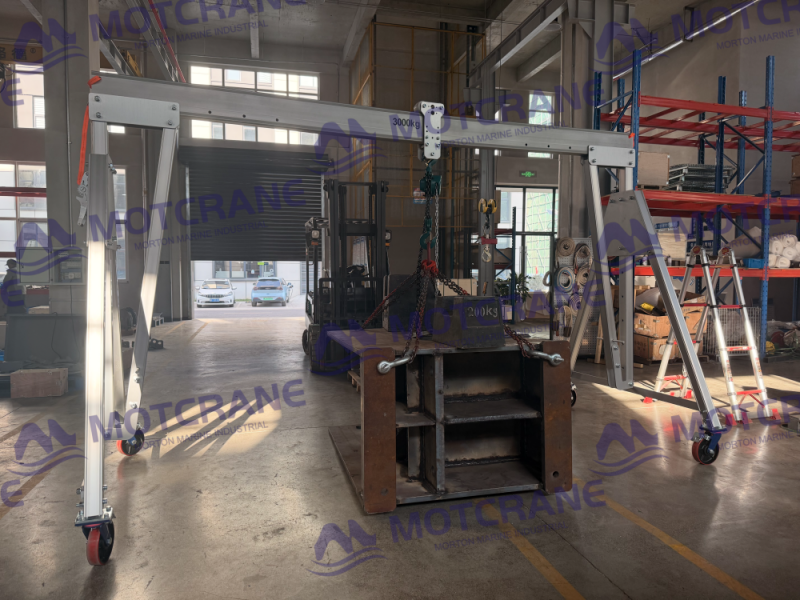
A previous MOTCRANE project shows how this works in practice. We supplied three 3-metric-ton adjustable-height aluminum gantry cranes to a large shipyard in Dubai for lifting Siemens components at different workstations.
The crane height could be adjusted from 2,581 to 3,581 mm, while the span remained fixed at 3,920 mm.
In this project, the customer needed different working heights at different locations. Making the height adjustable solved that requirement without making the span adjustable.
Key Information for Choosing Between Fixed and Adjustable Height
Before selecting the height configuration, focus on the conditions that may actually require the crane height to change.
Required Hook-Height Range
Confirm the lowest and highest hook positions required for the different lifting tasks.
If there is very little difference between them, a fixed-height crane may already cover the full requirement.
Headroom and Doorway Clearance
Check whether the crane will work under different ceiling heights or needs to pass through doorways with limited clearance.
Sometimes an adjustable-height crane is useful not only for lifting higher, but also for lowering the structure when moving between areas.
Number of Working Areas
Confirm whether the crane will stay at one workstation or move between several areas.
Different workstations may have different equipment heights, overhead obstructions, and access limitations.
Adjustment Frequency
Consider how often the crane height will actually change.
If the height is set once and then remains unchanged for months or years, a fixed-height design may be more practical. If adjustment is required regularly between tasks, the adjustable structure provides more value.
Future Layout Changes
Consider equipment that may be added later, changes to maintenance areas, or future production-layout adjustments.
A project that appears fixed today may require different working heights later.
Lifting capacity and span must still be confirmed during the crane design, but they do not by themselves determine whether an adjustable-height structure is required. For the models discussed here, the span remains fixed.
FAQ
Can One Adjustable-Height Aluminum Gantry Crane Replace Multiple Fixed-Height Cranes?
In some projects, yes.
One adjustable-height crane can serve several working areas if the required lifting capacity, fixed span, approved height range, access routes, and rated parameters for every task are all within the crane’s design limits.
Does an Adjustable-Height Crane Have the Same Lifting Capacity at All Height Positions?
Yes.
For MOTCRANE adjustable-height aluminum gantry cranes, the rated lifting capacity is maintained throughout the approved height-adjustment range defined during the design stage.
The crane must be used only at the specified height positions, with the locking system fully secured.
Can a Fixed-Height Aluminum Gantry Crane Be Converted to an Adjustable-Height Model Later?
No.
A fixed-height crane should not be converted on site by simply drilling holes or adding locking pins. An adjustable-height model uses a different column and locking structure that must be included in the original structural design and calculation.
If you may need height adjustment in the future, specify this before the crane is manufactured.
Can the Height Be Adjusted While a Load Is Suspended?
No.
The crane must be completely unloaded before any height adjustment is made. The adjustment should be carried out on a stable, level surface, and all locking pins and connecting components must be properly secured before lifting resumes.
Summary
For a fixed height vs adjustable height aluminum gantry crane decision, the key question is whether your required working height will remain stable or change between tasks. If your workstation and required hook height will remain stable for long-term use, a fixed-height aluminum gantry crane is normally the simpler option.
If one crane needs to serve different equipment, different working heights, or several areas with different clearance conditions, an adjustable-height aluminum gantry crane provides greater flexibility.
Before deciding, confirm the required hook-height range, headroom, doorway clearance, number of working areas, adjustment frequency, and possible future layout changes.
When requesting a solution, provide MOTCRANE with site photos, load dimensions and lifting points, required hook height, span, travel routes, and future usage plans. These details make it easier to determine whether a fixed-height crane is sufficient or whether adjustable height will provide real value for your project.



 English
  Russian
  French
  Spanish
  Arabic
  Indonesian
  Japanese