


FEM Standard vs Conventional Single-Girder Overhead Crane: When Is the Upgrade Worth It?
You are comparing two quotations for a 5-tonne single-girder overhead crane. One uses a conventional wire rope hoist and standard travel controls, while the other features a European-style hoist and variable-frequency drives (VFDs). Both cranes have the same rated capacity, but their purchase costs differ.
The question is not which crane has the higher specification, but whether the additional features solve a problem in your operation.
For some factories, a conventional single-girder crane is sufficient. For others, hoisting duty, available headroom or positioning requirements may justify an upgrade.
1. When Is a Conventional Single-Girder Overhead Crane Sufficient?
If you mainly use a crane for equipment maintenance, mould replacement or intermittent material handling, a conventional single-girder crane may be the more practical choice, provided its duty classification, hook height and operating performance meet your requirements.
For example, if you carry out only a few lifts each day, handle relatively light loads and have sufficient workshop headroom, a conventional configuration may already meet your hoisting, travelling and positioning needs. Adding a European-style hoist or more sophisticated controls may offer little practical benefit relative to the extra cost.
Consider a typical handling operation. Can the crane lift the load, travel along the planned route and stop safely at the required position? If the conventional arrangement has been verified to perform these tasks and no additional functions are needed, there is a sound reason to keep the simpler configuration.
2. Do Your Lifting Operations Require a Higher Duty Classification?
Consider two factories using 5-tonne overhead cranes. One occasionally handles light components, while the other repeatedly lifts loads close to 5 tonnes. Although their rated capacities are identical, their duty requirements may differ.
The complete crane and its hoisting mechanism must be classified separately. A3 and A5 refer to overall crane duty classes, while M3 and M5 refer to mechanism classes. An M5 hoist does not automatically make the complete crane A5.
The appropriate classification depends on operating cycles over the crane’s expected service life, the distribution of lifted loads and the demands placed on the hoisting mechanism.
Ask your technical team to verify the crane and hoisting mechanism classifications separately against the applicable standards and confirm that both match the intended operating conditions. A5 is not automatically a better choice than A3 for every application.
3. Will an FEM Standard Configuration Actually Increase Your Usable Hook Height?
FEM Standard single-girder cranes often use a more compact hoist arrangement, but this does not mean every European-style configuration provides a higher hook position than a conventional crane.
For a workshop with limited headroom, the important question is how high the hook can actually reach when both cranes use the same runway rail elevation.
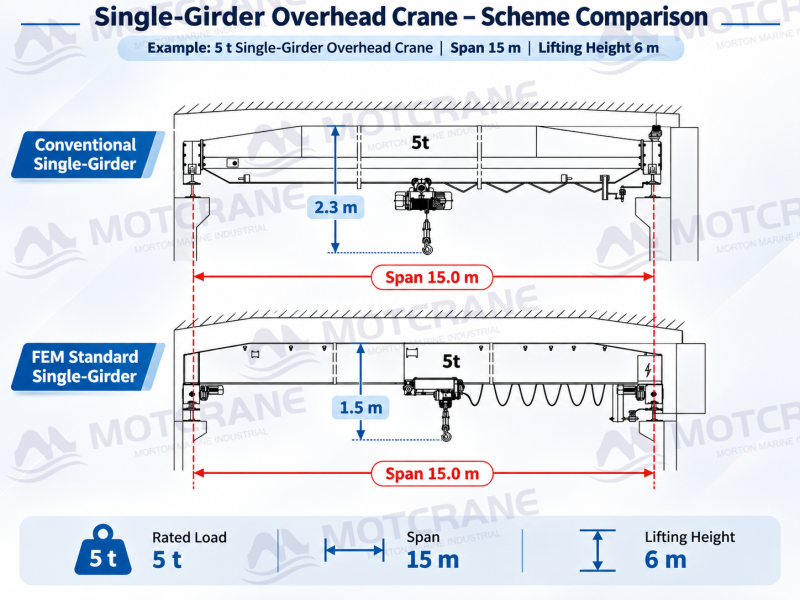
For illustration, the drawing below compares two 5-tonne single-girder overhead crane arrangements with a 15 m span and a 6 m lifting height. The vertical distance from the top of the crane to the hook at its highest position is 2.3 m for the conventional arrangement and 1.5 m for the FEM Standard arrangement. However, this 800 mm difference does not automatically translate into an equal increase in usable hook height. The actual improvement must be verified using the general arrangement drawings at the same runway rail elevation.
You should also check the hook approach distances at both ends. The hook must reach the required pick-up and set-down positions, not just the required height. Use the actual general arrangement drawings to compare both proposals.
4. Do You Need a Complete FEM Configuration or Only Selected Upgrades?
MOTCRANE offers three configurations for single-girder overhead cranes:
| Option | Main Configuration | When to Consider It |
| A. Standard Single-Girder | Fabricated I-section main girder, conventional CD-type wire rope hoist and standard fixed-speed travel controls | Routine handling where the basic configuration meets operating requirements |
| B. European-Style Girder Configuration | European-style box girder, traditional wire rope hoist and travel controls configured as needed | Applications with specific structural or travel requirements |
| C. FEM Standard Single-Girder | European-style box girder and wire rope hoist with matched drives and controls | Applications requiring a compact arrangement, appropriate duty classification or specific operating performance |
If your main concern is abrupt acceleration or deceleration during bridge travel, first consider whether a compatible VFD travel system would solve the problem. However, if the hoisting mechanism cannot meet the required duty classification, changing the bridge drive will not address that limitation.
Any modification must be checked against the complete crane design. Using a box girder does not automatically increase the crane’s duty classification, and adding a VFD does not replace the brakes or essential safety functions.
5. How Can You Determine Whether the Additional Cost of an FEM Upgrade Is Worthwhile?
Before comparing prices, make sure both quotations are based on the same lifting capacity, span, runway rail elevation, duty requirements and operating conditions.
Then compare the following:
| Comparison Item | What You Need to Confirm |
| Duty Classification | Overall crane and hoisting mechanism classifications |
| Working Envelope | Highest hook position and hook approach distances at both ends |
| Operating Performance | Hoisting speeds, positioning performance and which mechanisms use VFD control |
| Scope of Supply | Power supply arrangements, rails, installation responsibilities and spare-parts support |
Look beyond the equipment purchase price. An upgrade may justify its additional cost if it avoids building modifications, meets a required duty classification or improves a critical part of your handling process. Any expected savings in energy or maintenance costs should be supported by project-specific data.
For a project in Thailand, the customer required fifteen 5-tonne low-headroom overhead cranes for 10 workshops with different building heights. Each crane had a 19.5 m span and a specified lifting height of 6 m. The customer also needed suitable duty performance and travel drives with local service support, while keeping procurement costs under control.
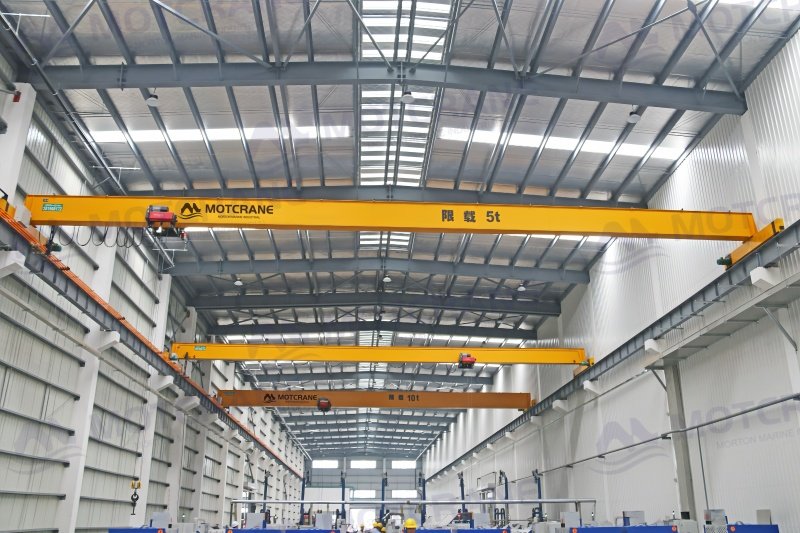
MOTCRANE compared different combinations of hoists, travel drives and control components. The selected configuration combined Chinese-manufactured European-style wire rope hoists with SEW travel drives and INOVANCE VFDs. This met the project’s specified technical requirements without relying entirely on imported components, allowing the customer to control costs through component selection even after choosing an FEM Standard arrangement.
FAQ
Q1. Can an FEM Standard single-girder overhead crane be installed outdoors?
Yes, if designed for outdoor service. Wind loads, rainfall and electrical equipment protection must be considered. A standard indoor configuration is not automatically suitable.
Q2. Can I replace only the hoist on my existing single-girder overhead crane with a European-style model?
It may be possible, but the girder, mounting arrangement, loads, electrical interfaces and safety functions must be checked. Replacing the hoist does not automatically increase the complete crane’s duty classification.
Q3. Can an FEM Standard single-girder overhead crane have both wireless remote control and a wired pendant?
Yes. Appropriate control-station selection and interlocking should prevent simultaneous operation from different stations.
Conclusion
An upgrade is worth considering when it solves a specific problem in your lifting operation.
If you are comparing different crane configurations, send MOTCRANE your workshop drawings, typical load weights, expected lifting frequency and any available technical specifications.
We can review the duty classifications, hook positions and drive arrangements, then develop a conventional, partially upgraded or FEM Standard single-girder crane configuration and quotation suited to your application.



 English
 Russian
 French
 Spanish
 Arabic
 Indonesian
 Japanese