


When Is a Single Girder Overhead Crane the Right Choice?
A single girder overhead crane is suitable for many factories, warehouses, and maintenance areas. Deciding when to choose a single girder overhead crane requires considering the lifting task, duty class, headroom, and building conditions.
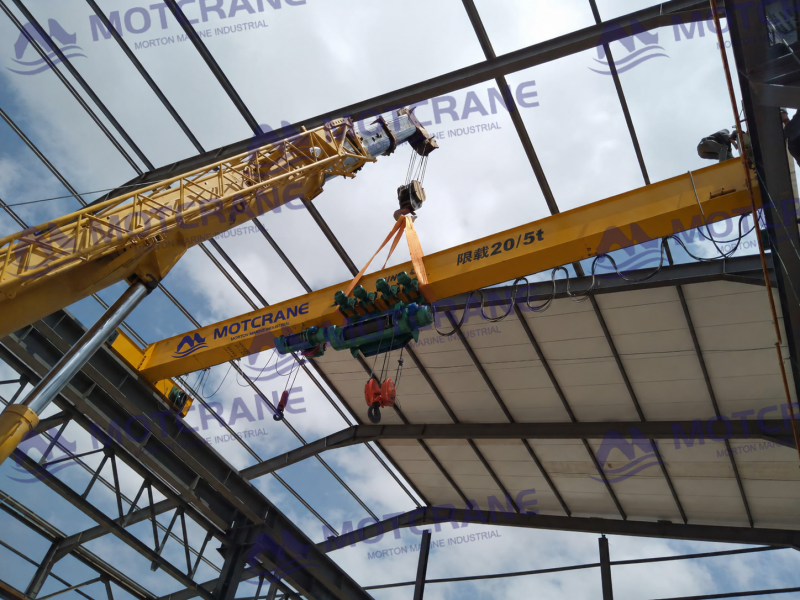
When to Choose a Single Girder Overhead Crane
For many workshops, a single girder overhead crane is the first option to consider because the structure is relatively simple and can cover most routine lifting work. However, lifting capacity alone is not enough to decide whether it is the right choice.
Before selecting a single girder crane, look at the load, operating frequency, required hook height, workshop structure, and the way the crane will actually be used.
1. The Load Is Within a Suitable Range
Single girder overhead cranes are commonly used for light- and medium-capacity lifting. MOTCRANE standard single girder configurations are generally available for capacities up to 20 metric tons.
The actual load should include not only the item being lifted, but also any lifting beam, clamp, spreader, or other attachment. Load dimensions and lifting points also matter. A compact 10-ton machine and a 10-ton long steel structure may require very different lifting arrangements even though the weight is the same.
2. The Crane Is Used for Normal Workshop Handling
A single girder crane is well suited to routine material handling, equipment maintenance, assembly, loading, and transferring parts between workstations.
If the crane only operates intermittently during the day, a standard configuration may be sufficient. If it will run for long periods, make many lifts per hour, or regularly handle loads close to its rated capacity, the required duty class should be checked carefully before the crane configuration is confirmed.
3. The Span and Hook Height Meet the Workshop Requirements
The crane must cover the required working area while still providing enough hook height for the lifting task.
In a workshop with sufficient headroom, a standard LD-type single girder crane is often suitable. Where installation height is limited, a low-headroom hoist or European-style single girder design can help provide more usable hook height without making major changes to the building.
4. The Existing Building Can Support the Crane
For an existing factory, the runway beams, crane brackets, columns, and supporting structure should be checked before the crane is selected.
This is especially important in renovation projects. Even when the lifting capacity is not high, the existing building may not have been designed to carry crane loads. In that case, the supporting structure may need to be reinforced or an independent crane support system considered.
5. The Lifting Process Does Not Require a More Complex Crane
For ordinary workshop lifting, a single girder crane is usually enough.
However, projects involving high-frequency production, very long loads, special lifting devices, high positioning accuracy, metallurgical operations, high temperatures, or other demanding conditions need further evaluation.
In these cases, the final decision should compare single girder and double girder overhead cranes rather than selecting the crane only by tonnage.
In What Scenarios Are Single Girder Overhead Cranes Typically Used?
Single girder overhead cranes are commonly used for material handling within a fixed workshop area.
Typical applications include:
- Machining workshops: Moving molds, machine parts, and equipment components between workstations.
- Equipment maintenance: Removing and reinstalling motors, gearboxes, pumps, and other mechanical parts.
- Warehouses and assembly areas: Handling raw materials, finished products, and equipment components between storage and assembly positions.
- Structural steel workshops: Moving beams, plates, and fabricated components between cutting, welding, assembly, and storage areas.
These applications are usually suitable when the lifting route is clear, the handling area is fixed, and the operating frequency is within the required duty class. A similar approach was used in our Turkey factory crane project, where 5-ton single girder cranes were selected for daily assembly work while a 50/20-ton double girder crane handled larger steel structures.
What Types of Loads Are They Suitable for Lifting?
Load capacity is another key factor in deciding when to choose a single girder overhead crane, and these cranes are commonly used for loads of 20 metric tons or less.
Extra-long loads usually require special lifting attachments, such as lifting beams, clamps, vacuum lifters, or other specialized devices, to keep the load properly balanced. The weight and operating method of these attachments must also be considered during crane selection.
Which Single Girder Configuration Fits Your Project?
Understanding these project conditions makes it easier to determine when to choose a single girder overhead crane and which configuration is suitable.
Standard LD Single Girder Crane
If the operating frequency, span, and available headroom are relatively standard, an LD-type single girder overhead crane may be sufficient for routine workshop material handling.
Low-Headroom Single Girder Crane
If the available installation height is limited, a low-headroom electric hoist and optimized main girder arrangement can increase the usable hook height.
An LDC or European-style single girder crane should be considered when maximizing lifting height is more important than using the lowest-cost standard configuration.
European-Style Single Girder Crane
If the project requires higher operating frequency, smoother travel, variable-frequency control, or a higher duty class, a European-style single girder crane may be more suitable.
The hoist, travel motors, brakes, and control system can be configured according to the required operating conditions. See our 5-ton low-headroom crane project in Thailand for a practical example.
What Information Should You Confirm Before Selecting a Single Girder Crane?
Lifting capacity: Confirm the maximum load weight, including lifting attachments.
Span: Confirm the distance between the crane runway centerlines or provide the workshop width and runway layout.
Required hook height: Confirm the required maximum hook position rather than only the total workshop height.
Operating frequency: Provide daily operating hours, approximate lifts per hour, and typical load conditions.
Building conditions: Confirm available headroom, runway beam conditions, column spacing, and supporting capacity.
Control requirements: Confirm whether fixed-speed or variable-frequency control is required and whether operation will use pendant or wireless remote control.
Future production plans: Consider whether the production line, crane coverage area, or operating frequency may change later.
Frequently Asked Questions
Can the Lifting Capacity of a Single Girder Overhead Crane Be Increased Later?
Generally, no. Increasing the lifting capacity requires recalculating the load-bearing capacities of the main girder, end beams, wheels, runway beams, and supporting structures, as well as replacing the hoist.
Can a Single Girder Overhead Crane Be Installed in an Existing Factory Building?
Yes, but the available installation height and the building’s load-bearing capacity must first be verified.
If the existing building cannot support the crane loads, a free standing bridge crane with independent support columns can be considered. However, the additional columns may reduce the available crane span.
What Configuration Options Are Available for a Single Girder Overhead Crane?
Crane configuration: Conventional single girder design or European-style single girder design;
Hoisting mechanism: Electric chain hoist, electric wire rope hoist, or European-style wire rope hoist;
Speed control: Fixed-speed operation or variable-frequency speed control;
Gear motor brand: Chinese or international brands.
Summary
Understanding when to choose a single girder overhead crane requires considering the lifting task, duty class, headroom, and building conditions. For many factories, warehouses, and maintenance areas, these factors determine whether a standard single girder solution is suitable.
Before requesting a quotation, it is recommended to prepare the following information: lifting capacity, span, required hook height, load type, daily operating hours, number of lifts per hour, factory layout drawings, and on-site photographs.
Based on this information, MOTCRANE can determine whether a standard single girder overhead crane solution is appropriate or whether a low-headroom design, higher duty class, double girder crane, or another configuration is required.



 English
  Russian
  French
  Spanish
  Arabic
  Indonesian
  Japanese