


Why Are Aluminum Gantry Cranes Designed to Be Lightweight?
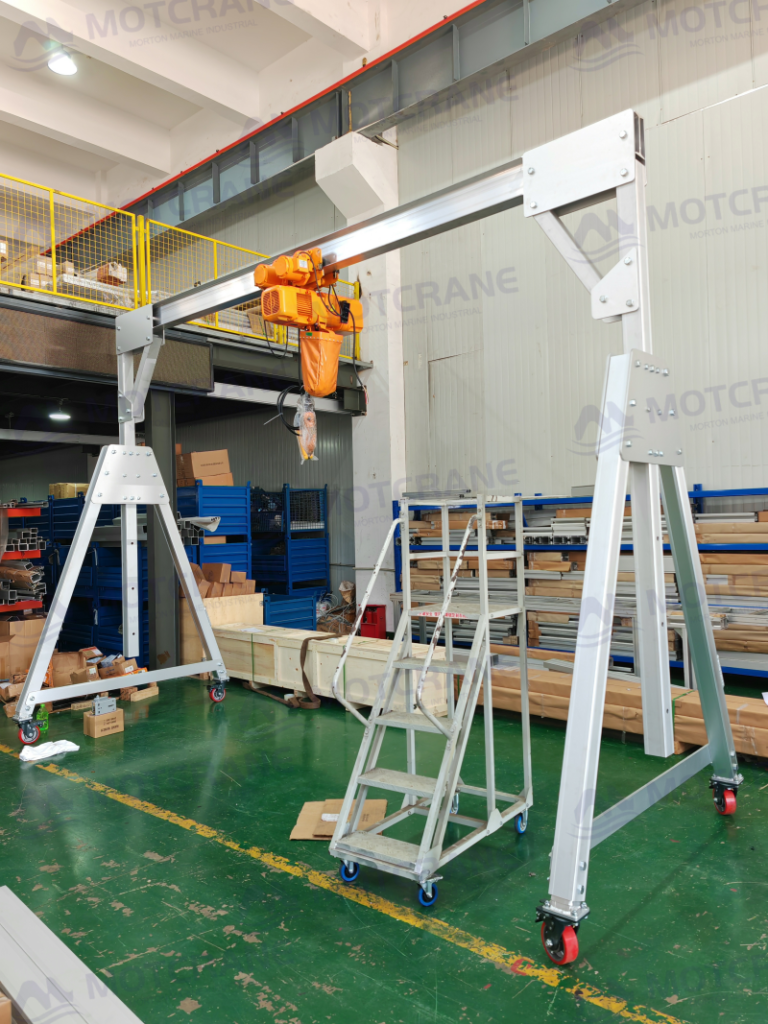
“We need a 5-metric-ton gantry crane for equipment maintenance, but the lifting location isn’t fixed. The crane needs to be moved between several maintenance stations, and we don’t want to rely on a forklift every time we change locations. We also want a design that can be assembled by a small team of 2–3 people.”
For projects like this, a lightweight aluminum gantry crane is often considered because the crane itself must be assembled, moved between work areas, and repeatedly redeployed. You also need to consider whether it can pass through site access routes, meet the required lifting height, and be dismantled and stored after the task is complete.
This is why lightweight design is emphasized in aluminum alloy gantry cranes. The goal is not simply to make the crane as light as possible, but to reduce unnecessary dead weight while meeting rated load, stiffness, deflection, stability, connection, and leg-load requirements. This makes the crane more suitable for applications that require repeated movement and redeployment.
Why Can’t You Judge a Mobile Gantry Crane Solely by Its Lifting Capacity?
The rated lifting capacity determines how much load the crane can safely lift, but for a gantry crane that needs to be moved frequently, this is only the first step in selection.
If your crane frequently changes workstations, you also need to consider how much the crane itself weighs, how it will be moved, whether it can pass through aisles and access routes, whether disassembly is required, and how many people are available on site for repositioning.
If a forklift or other auxiliary handling equipment must be called in every time the workstation changes, the practical value of “mobility” is significantly reduced.
For a mobile gantry crane, lifting capacity determines what it can lift, while dead weight, structural design, installation method, and mode of movement determine how practical it is to use on your site.
Why Is Lightweight Construction Emphasized in Aluminum Alloy Gantry Cranes?
Aluminum alloy has a lower density than steel, giving engineers more opportunity to reduce crane dead weight while still meeting the required capacity, stiffness, deflection, stability, connection, and leg-load requirements. According to European Aluminium, aluminum has about one-third the density of steel.
If your crane remains at one location for extended periods, dead weight is typically not a primary concern. However, if the same crane needs to be moved, disassembled, or transported to different sites frequently, its dead weight directly affects the handling and deployment process.
The value of lightweight construction therefore goes beyond the equipment weight shown on a specification sheet. It should make the crane easier to handle throughout its actual working cycle without sacrificing the structural requirements of the lifting task.
What On-Site Problems Can Lower Crane Dead Weight Help Solve?
1. Repositioning Between Multiple Workstations
If an aluminum alloy gantry crane needs to serve multiple workstations, each location change requires moving and repositioning the equipment. Lower self-weight reduces the handling effort involved.
However, you cannot assume that a lightweight crane can always be pushed manually.
The movement method should still be determined based on:
- total crane weight;
- caster specifications;
- rolling resistance;
- floor levelness and surface condition;
- travel distance;
- available personnel;
- steering requirements.
If manual repositioning is important to your workflow, these conditions should be confirmed before the crane configuration is finalized.
2. Transport to Different Sites After Disassembly
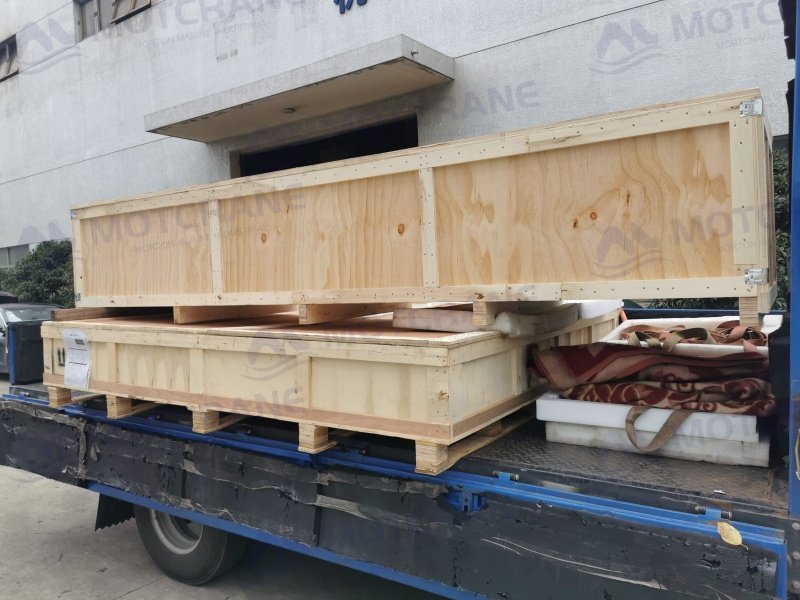
If the crane needs to accompany maintenance or installation teams to different project sites, you must also consider loading, transportation, unloading, and reassembly.
In this situation, the dimensions and individual weights of the disassembled components may be more important than the total weight of the complete crane.
If your site has limits on manual handling, forklift access, truck loading, doorway dimensions, or available personnel, you should confirm the largest component size and individual component weight after disassembly rather than looking only at the total crane weight.
This helps determine whether the crane can actually be transported and handled using the resources available at your site.
3. Temporary Deployment and Storage After the Task
Some maintenance projects only require lifting equipment for a limited period. After a motor replacement, pump overhaul, or equipment installation is completed, the gantry crane may need to be removed from the work area rather than remain permanently in place.
In this type of application, you should consider the complete process:
transport to site → assembly → positioning → lifting → set-down → disassembly → storage
A lighter, modular structure can reduce the handling effort required during assembly and disassembly, especially when only a small team is available.
Storage also becomes part of the selection process. You should check whether the dismantled components can be moved into the available storage area, whether the longest component fits through the access route, and whether additional lifting equipment is needed to handle the individual parts.
For a crane that is repeatedly deployed and stored, these practical details can be just as important as the rated lifting capacity.
When Should You Really Prioritize Low Self-Weight?
A lightweight aluminum gantry crane usually provides greater practical value when your workflow requires frequent repositioning, transport, or repeated deployment. This is especially relevant when:
- the crane needs to be repositioned frequently between maintenance or assembly stations while unloaded;
- the crane needs to be periodically disassembled and transported to different project sites;
- forklifts or other auxiliary handling equipment are not consistently available;
- doorways, passageways, or transport vehicles restrict equipment dimensions or individual component weights;
- only a small number of personnel are available for assembly, handling, and repositioning;
- lifting tasks are temporary and the crane must be disassembled and stored after use.
If these conditions do not generally apply and the crane will remain at one workstation for long-term use, other gantry crane designs, freestanding overhead cranes, or jib cranes may also be worth comparing.
For Which Projects Should Lightweight Not Be the Top Priority?
If your project involves higher lifting capacities, long spans, demanding duty requirements, or long-term use at a fixed workstation, minimizing crane dead weight is usually not the first design priority.
You should first confirm the required capacity, span, stiffness, stability, duty requirements, operating method, and expected service life before deciding whether an aluminum or steel structure is more appropriate.
The purpose of lightweight design is to improve the workflow where mobility matters—not to make low crane weight the primary target for every lifting project.
Key Information to Confirm Before Selecting a Model
If you are evaluating a lightweight aluminum alloy gantry crane, confirm the following information first:
- What will be lifted, and what is the maximum actual load including lifting attachments?
- What clear span, hook height, and overall height limits are required?
- Will the crane remain at one workstation or move between multiple work areas?
- What are the estimated distance and frequency of each move?
- Is loaded travel required and, if so, does a motorized travel system need to be specifically designed for that operating condition?
- What doorway, passageway, and turning-space restrictions apply?
- Is the site floor level and suitable for the intended caster travel route?
- Is disassembly required for transport, and are there limits on the dimensions or weight of individual components?
- How many operators are normally available for assembly and repositioning?
- Are forklifts or other handling equipment available on site?
This information is far more useful than simply stating, “I want a lighter gantry crane.”
Based on your lifting task, mobility requirements, and site conditions, MOTCRANE can determine whether an aluminum alloy gantry crane is suitable and then configure the structure, casters, hoisting mechanism, and height arrangement around the actual workflow.
Summary
The purpose of a lightweight aluminum gantry crane is not to achieve the lowest possible dead weight. It is to reduce unnecessary structural weight so the crane is better suited to transportation, unloaded repositioning, disassembly, and repeated deployment.
If your crane will remain at one workstation and operate under demanding or heavy-load conditions, low dead weight may not be the first design priority. If the crane itself needs to be moved, transported, assembled, and stored frequently, its weight becomes an important part of practical operating efficiency.
Ultimately, the question is not “Which crane is lighter?” but “Does this crane’s weight and structure truly serve your workflow?”
If you are not sure whether lightweight construction will provide a real benefit for your project, send MOTCRANE your load weight, required span and lifting height, workstation layout, travel distance, doorway dimensions, floor conditions, available personnel, and transport requirements. We can review these conditions before recommending an aluminum gantry crane configuration, helping you avoid paying for mobility features that your project does not need—or selecting a crane that is difficult to move and deploy in actual use.



 English
  Russian
  French
  Spanish
  Arabic
  Indonesian
  Japanese