


Steel vs Aluminum Gantry Crane Under 5 Tons: Which Should You Choose?
Steel vs aluminum gantry crane selection is a common question when businesses need a mobile gantry crane with a lifting capacity of up to 5 metric tons.
Steel gantry cranes are heavier and usually offer better stability and long-term durability, while aluminum alloy gantry cranes are lighter, easier to move, faster to set up, and more convenient for manual height adjustment.
However, for light and medium-duty lifting applications, the right choice is not decided by material alone. It depends on how the crane will actually be used.
For example, a 2-ton, 3-ton, or near-5-ton lifting task may lead to different crane choices depending on whether the crane is kept in the same production area for long-term use or moved frequently between different workstations by a maintenance team.
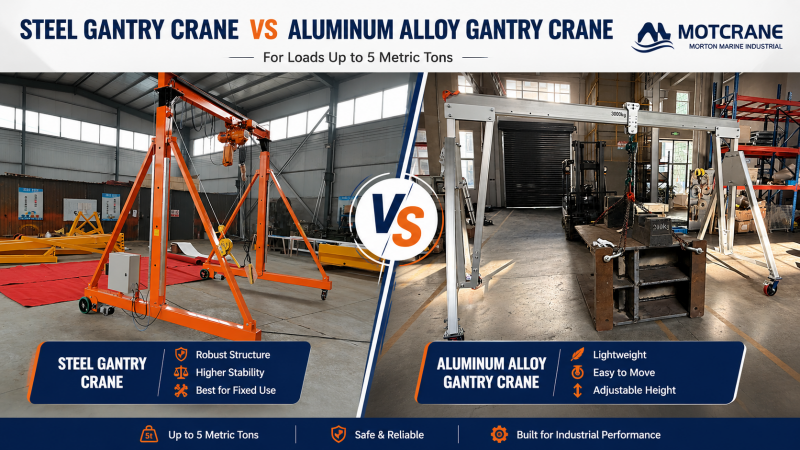
Steel vs Aluminum Gantry Crane: Quick Guide
If the lifting task is mainly fixed in one area, used frequently, or requires better structural stability and long-term reliability, a steel gantry crane is usually the better choice.
If the project requires frequent movement, quick setup, cross-area maintenance, or operation by a small team responsible for handling, assembly, storage, and height adjustment, an aluminum alloy gantry crane usually has more advantages.
This steel vs aluminum gantry crane comparison is mainly for small and medium-duty lifting applications under 5 metric tons.
| Comparison Factor | Steel Gantry Crane | Aluminum Alloy Gantry Crane |
| Equipment Weight | Heavier | Lighter |
| Ease of Movement | Moderate | Better |
| Height Adjustment | Manual crank or hydraulic lifting; manual crank is simple, hydraulic lifting is more complex | Usually supports manual or hand-crank adjustment |
| Travel Method | Manual pushing may be considered up to 3 metric tons; motorized travel is usually recommended above 3 metric tons | More suitable for manual pushing |
| Typical Applications | Fixed workstations, production support | Maintenance, repair, temporary lifting |
For small-tonnage lifting projects under 5 metric tons, customers may also consider KBK cranes or freestanding workstation cranes. These systems are usually fixed to the floor with steel or aluminum columns and work more like small freestanding overhead cranes. They are better suited for light material handling within a fixed area.
This article focuses on the comparison between steel gantry cranes and aluminum alloy gantry cranes, especially for applications that require mobility, relocation, or temporary lifting.
First, Consider How the Crane Will Be Used
Before choosing between steel and aluminum alloy, it is important to understand the lifting routine.
Will the crane be used every day for repeated production tasks, or only occasionally for maintenance and repair? Will it stay in one working area, or does it need to move between multiple workstations?
For fixed operations such as production line support, mold changes, or workpiece transfer, the stability and durability of a steel gantry crane may be more valuable.
For motor repair, equipment assembly and disassembly, temporary lifting, or maintenance work across different areas, the lightweight structure and quick setup of an aluminum alloy gantry crane can be more practical.
The real question is not simply whether the crane can lift 3 or 5 metric tons. The more important question is whether the crane fits your working rhythm, movement frequency, and available manpower.
Height Adjustment and Travel Method Matter
In a steel vs aluminum gantry crane decision, height adjustment and travel method are often more important than material alone. In addition to being lightweight, aluminum alloy gantry cranes usually support manual height adjustment. Depending on the design, the adjustment range can reach about 2 meters, making the crane suitable for different workstations and lifting height requirements.
There are two common height adjustment methods.
The first method is manual lifting. Operators raise the columns on both sides and then lock them with pins. The columns usually have adjustment holes spaced at 150 mm or 200 mm intervals. Because both sides must be raised evenly, this normally requires two people working together.
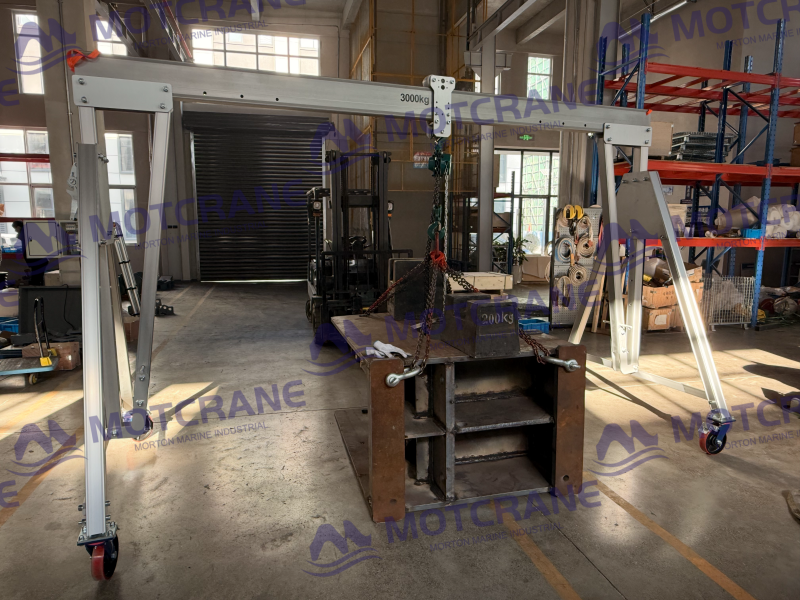
The second method is hand-crank adjustment. Two operators turn the cranks on both sides at the same time to raise or lower the columns, and then secure the structure with pins. This method is easier than direct manual lifting and is more suitable when height adjustment is required more often.
Steel gantry cranes can also be designed with adjustable height. A manual crank mechanism is not complicated, but because the steel structure is heavier, operation usually requires more effort than with an aluminum alloy crane.
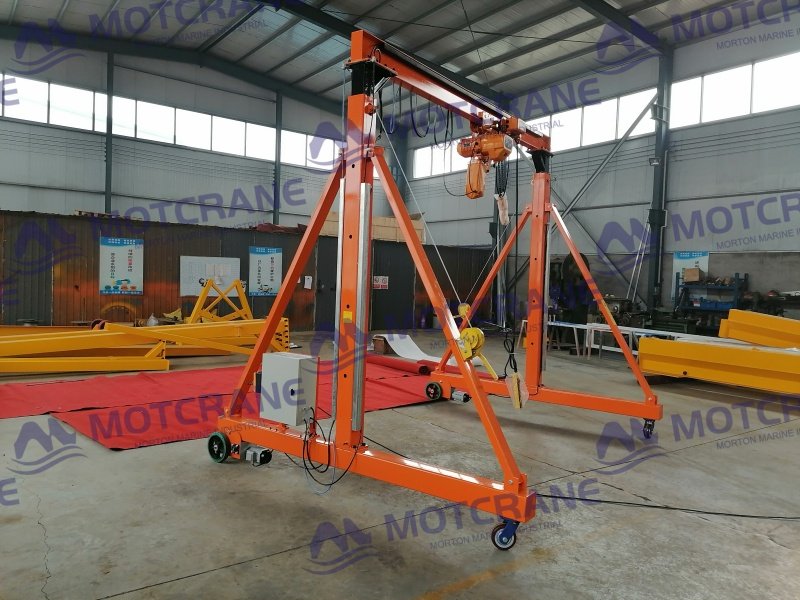
The more complex option is hydraulic cylinder lifting. Hydraulic lifting can make height adjustment easier, but it adds hydraulic cylinders, a hydraulic system, synchronization requirements, and additional safety considerations. For a steel gantry crane with hydraulic lifting, the structure, travel method, and control system usually need to be considered as a complete design.
The travel method is also important. A crane should not be selected as fully manual only because manual pushing is technically possible. The key question is whether workers can actually push the crane safely when it is fully loaded.
In practice, hand-pushed gantry cranes are more common for capacities up to 3 metric tons. For capacities above 3 metric tons, or when the crane has a heavy dead weight or is used frequently, motorized travel is usually recommended.
Site Conditions Also Affect the Choice
If the floor is level, the operating area is fixed, and the lifting frequency is high, a steel gantry crane is often more suitable for stable long-term use.
If the crane needs to be moved frequently, access routes are limited, or only a small team is available on site, the lightweight and portable design of an aluminum alloy gantry crane becomes more useful.
The working environment should also be considered. In damp, salt-fog, or corrosive environments, steel gantry cranes usually require painting, galvanizing, or other surface treatment to improve corrosion resistance. Aluminum alloy materials generally offer better corrosion resistance as part of the material itself.
Consider Future Requirements
Future changes should also be reviewed before making a decision.
If the current lifting requirement is 1 or 2 metric tons but may increase to nearly 5 metric tons, or if the crane may take on more fixed production tasks later, a steel gantry crane may be the safer long-term choice.
If the future requirement is more likely to involve moving between different areas, temporary lifting tasks, or frequent height adjustment, an aluminum alloy gantry crane is usually more flexible.
Frequently Asked Questions
Can aluminum alloy gantry cranes handle loads up to 5 metric tons?
Some aluminum alloy gantry cranes can be designed for higher capacities, depending on the structure and working conditions. However, they are more commonly used for light and medium-duty lifting. If the load is close to 5 metric tons, span, lifting height, frequency of use, travel method, and safety margin should be carefully reviewed.
Can steel gantry cranes be pushed by hand?
Yes, but the important question is whether the crane can actually be pushed safely when fully loaded. In general, manual pushing may be considered for capacities up to 3 metric tons, depending on site conditions. For capacities above 3 metric tons, motorized travel is usually recommended.
Which crane is better for a small maintenance team?
If two or three people need to move, assemble, adjust, and store the crane, an aluminum alloy gantry crane is usually more suitable. If the crane will stay in one area for long-term use, a steel gantry crane can also be a practical choice.
Summary
For most steel vs aluminum gantry crane projects under 5 metric tons, the right choice depends on working method, movement frequency, height adjustment needs, and site conditions.
Steel gantry cranes are better suited for fixed working areas, frequent lifting, and applications that require stronger stability. Aluminum alloy gantry cranes are better suited for quick setup, frequent movement, small-team operation, cross-area maintenance, and regular height adjustment.
If you are not sure which option is more suitable, send MOTCRANE your lifting capacity, span, lifting height, movement frequency, height adjustment needs, travel method, and site photos. Our engineers can help you choose a gantry crane solution based on your actual working conditions for loads up to 5 metric tons.



 English
  Russian
  French
  Spanish
  Arabic
  Indonesian
  Japanese