


What Is a Marine Crane? Types, Applications, and Selection Guide
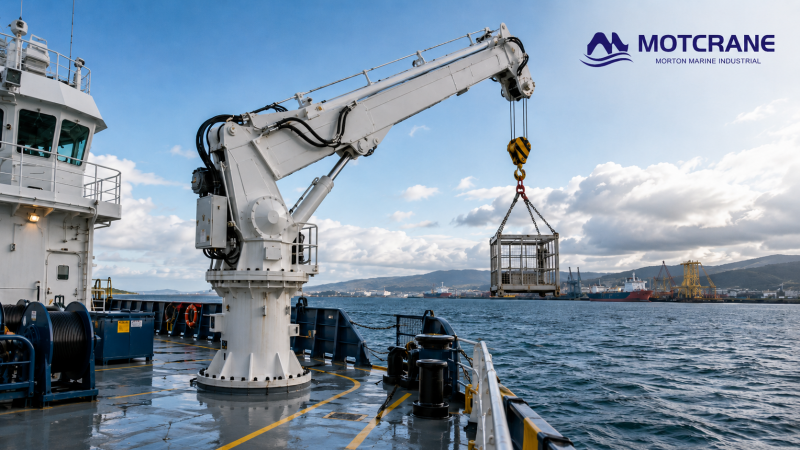
A marine crane is designed for lifting work on ships, offshore platforms, and port service vessels. Unlike a standard industrial crane, it must operate in limited deck space while exposed to vessel motion, salt spray, high humidity, and changing sea conditions.
For this reason, marine crane selection rarely starts with lifting capacity alone. Vessel type, deck layout, working radius, operating duty, installation position, and classification society requirements all influence the final design. Understanding what is a marine crane is not only about identifying the equipment type. The working radius, deck layout, vessel conditions, and certification requirements are equally important when selecting the right crane.
What Is a Marine Crane?
A marine crane is used for cargo handling, equipment transfer, deck operations, lifeboat handling, and offshore support work.
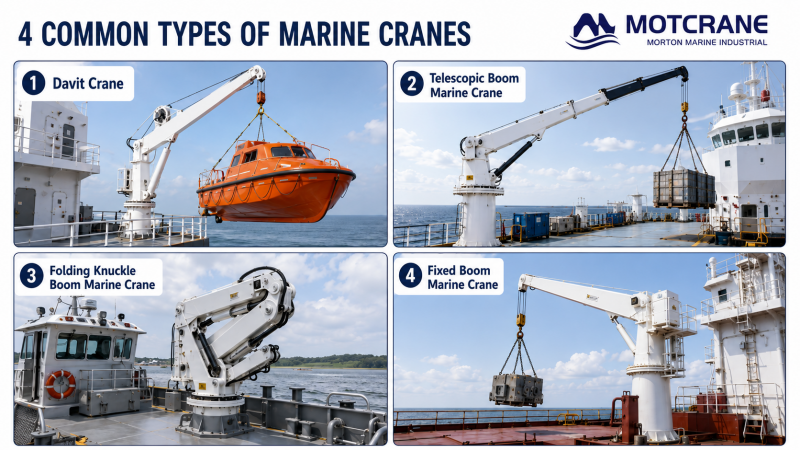
Common marine crane types include:
- Davit crane: Used to launch and recover lifeboats, rescue boats, and emergency equipment.
- Telescopic boom marine crane: Extends the boom to provide a longer working radius and is commonly used for handling supplies, equipment, and deck cargo.
- Folding knuckle boom marine crane: Folds into a compact position when not in use and provides greater flexibility around other deck equipment.
- Fixed boom marine crane: Uses a fixed-length boom and is suitable for straightforward lifting tasks where the working radius is clearly defined.
Each design serves a different purpose. The correct choice depends less on which type appears more advanced and more on how well it fits the vessel and its daily work.
Marine Crane vs. Industrial Crane
Marine cranes mainly handle dynamic loads caused by vessel movement and changing sea conditions. They also require stronger corrosion protection, compact structural arrangements, reliable hydraulic systems, and additional safety functions.
Depending on the project, the crane may require approval from ABS, DNV, BV, LR, CCS, or another classification society. These requirements can affect material grades, welding procedures, structural calculations, inspections, and documentation.
Industrial cranes are normally installed in factories, warehouses, and other land-based facilities. Their operating environment is more stable, corrosion requirements are usually lower, and classification society approval is generally not required.
Although some column-mounted jib cranes look similar to small marine cranes, the design requirements are quite different. A marine crane must be designed for vessel motion, saltwater exposure, limited deck space, and the required certification scope. It is not simply an industrial jib crane with marine paint.
How Does a Marine Crane Work?
A typical marine crane includes a boom, pedestal, slewing system, hoisting system, hydraulic power unit, and control system.
Its three main movements are:
- Hoisting: Raising and lowering the load.
- Luffing: Changing the boom angle and working radius.
- Slewing: Rotating the crane to cover different parts of the deck.
For cranes used frequently, the reliability of the hydraulic system, winch, slewing mechanism, seals, and control components can be just as important as the maximum rated capacity.
How to Choose a Marine Crane
Choosing a marine crane starts with the actual lifting task, not simply the maximum tonnage. Before asking for a quotation, you should confirm the working radius, deck conditions, operating frequency, and certification requirements.
1. Confirm Capacity at the Required Working Radius
When you request a marine crane quotation, do not provide the lifting capacity alone.
A crane rated for 5 metric tons may only lift that load at a shorter radius. As the working radius increases, the available lifting capacity normally decreases.
For example, if your actual requirement is 3 metric tons at a 10-meter working radius, provide this load-radius combination directly. This allows the supplier to size the boom, hydraulic system, winch, and crane structure around your real lifting condition instead of working from tonnage alone.
2. Match the Boom Type to Your Working Area
If your lifting area is short and clearly defined, a compact fixed-boom crane may be sufficient.
If you need a longer outreach, a telescopic boom crane is usually more practical. Where deck space is limited or the boom needs to occupy less space when stored, a folding knuckle boom crane may be a better option.
The boom type should follow your working radius and deck layout rather than personal preference.
3. Check Your Deck Layout
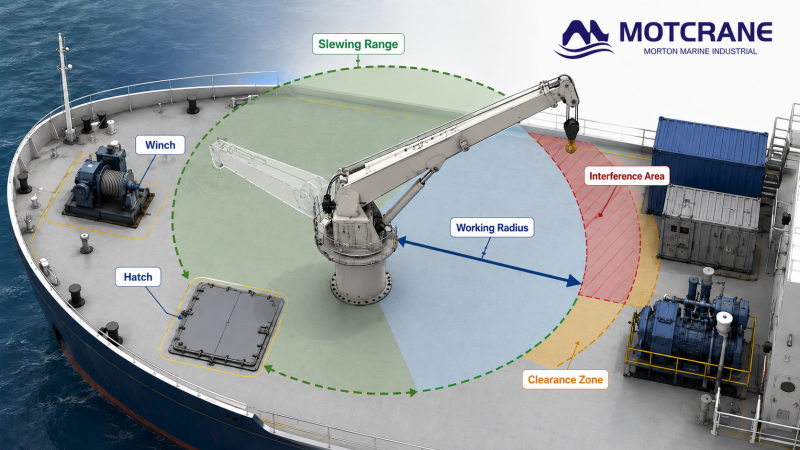
Before confirming the crane type, check the position of winches, hatches, guardrails, containers, piping, and other nearby equipment.
You should review both the crane’s slewing area and the boom position when the crane is stowed.
On a crowded deck, these clearances can determine whether a telescopic, folding, or fixed-boom crane is practical.
4. Review Vessel Stability and Deck Strength
If you are installing a crane on an existing vessel, check the deck structure, pedestal foundation, and vessel stability before the crane design is finalized.
Crane dead weight, installation position, lifted load, and working radius all affect the loads transferred to the vessel. If the existing structure is not sufficient, additional reinforcement may be required.
5. Confirm Classification Requirements Early
If your project requires ABS, DNV, BV, LR, CCS, or another classification society, confirm this before the final quotation.
Certification requirements can affect material selection, welding procedures, structural calculations, component selection, inspections, documentation, delivery time, and cost.
Confirming the class requirement after production has started can lead to redesign and additional expense.
(The current list of recognized member organizations can be reviewed on the IACS member classification societies page.)
6. Consider How Often the Crane Will Be Used
A crane used occasionally does not have the same operating requirements as one working throughout every shift.
If your crane will operate frequently, provide the expected daily operating hours and approximate lifting cycles.
This helps determine the required winch duty, hydraulic system capacity, cooling arrangement, control components, and maintenance requirements.
A Marine Crane Selection Example
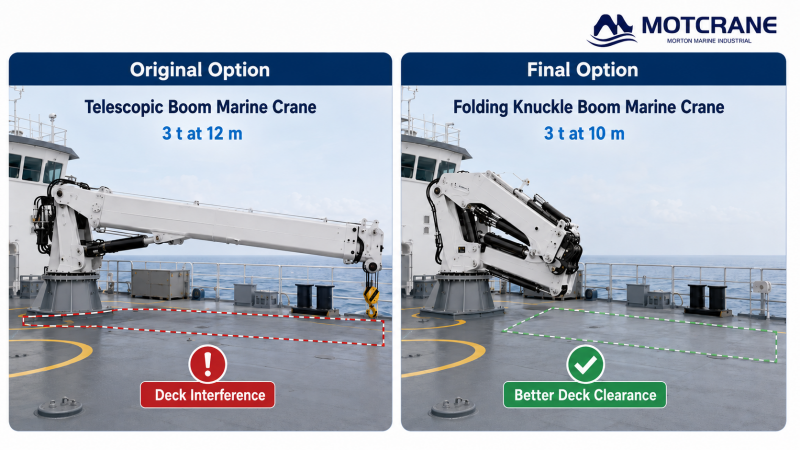
For a marine support vessel approximately 45 meters long, the original request was for a telescopic boom marine crane rated at 3 metric tons at a 12-meter working radius.
During the deck layout review, the crane’s slewing area was found to interfere with other equipment. There was also insufficient space to stow the proposed boom arrangement.
The final solution was a folding knuckle boom marine crane rated at 3 metric tons at 10 meters.
The folding-boom configuration was selected because it:
- occupied less space when stowed;
- avoided interference with existing deck equipment;
- provided more operating positions in a restricted working area.
This case shows why deck layout and working radius should be reviewed before the crane type is finalized. If your vessel has a crowded deck, checking the slewing envelope and stowed boom position early can help avoid redesign later in the project. For another compact deck lifting application, see this 2-ton foldable knuckle boom marine crane project.
Common Marine Crane Selection Mistakes
- Focusing Only on Lifting Capacity
Working radius directly affects lifting capacity. A crane selected only by its maximum tonnage may not meet the load requirement at the required outreach.
- Ignoring Installation and Storage Space
The slewing envelope, boom storage position, pedestal dimensions, and maintenance access should all be checked against the deck layout.
- Confirming Certification Too Late
Late confirmation of classification society requirements may lead to redesign, additional documentation, higher costs, and project delays.
- Comparing Only the Initial Price
Working radius, boom structure, component brands, corrosion protection, certification, spare parts, and future maintenance all affect the total cost of ownership.
What Affects Marine Crane Price?
Two marine cranes with the same lifting capacity can have very different prices.
The main cost factors include:
- rated load at the required working radius;
- boom type and maximum outreach;
- hydraulic and control component brands;
- corrosion protection system;
- operating duty;
- classification society certification;
- installation and commissioning requirements;
- special functions such as active heave compensation.
When you compare quotations, make sure each supplier is pricing the same technical scope. A lower price may simply be based on a shorter working radius, different component brands, or a different certification scope.
You also do not need the highest specification for every project. If your crane does not require classification approval, active heave compensation, redundant systems, or other special functions, adding them will increase both the equipment cost and system complexity.
For this reason, it is better to define the actual operating requirements first and then compare quotations on the same basis.
What Information Should You Prepare for a Marine Crane Quote?
Before requesting a quotation, prepare the following project information:
- vessel type;
- preferred crane type, if known;
- lifting capacity at the maximum working radius;
- maximum working radius;
- installation position;
- deck layout or available installation dimensions;
- operating frequency and sea conditions;
- available power supply;
- classification society requirement.
Complete project information allows the supplier to review the crane structure, working envelope, installation conditions, and certification scope before preparing a quotation.
Frequently Asked Questions
- What size marine crane is suitable for a small vessel?
Small vessels commonly use marine cranes in the 1- to 5-metric-ton range. The final size depends on working radius, deck space, vessel stability, and the actual lifting task.
- Can a marine crane be installed on an existing vessel?
Yes, but the deck strength, pedestal foundation, installation position, and vessel stability must be checked first. Structural reinforcement may be required.
- How long does a marine crane take to manufacture?
For many customized or classification-approved marine crane projects, manufacturing may take approximately 60 to 120 days, depending on design complexity, drawing approval, material inspection, and certification procedures.
- What maintenance does a marine crane require?
Regular checks should cover the hydraulic system, wire rope, winch, slewing mechanism, fasteners, seals, and corrosion protection. Marine cranes generally require more frequent inspection than comparable land-based equipment.
- Which marine crane is best for limited deck space?
A folding knuckle boom marine crane is often suitable for limited deck space because it has a smaller stowed footprint and can operate around nearby deck equipment.
Summary
Understanding what is a marine crane and how to select one requires more than comparing lifting capacities. Vessel type, working radius, deck layout, operating frequency, stability, corrosion protection, and classification society requirements can lead to very different solutions.
If you are planning a new vessel or upgrading existing deck equipment, request a marine crane solution from MOTCRANE with the crane type, lifting capacity at maximum radius, working radius, installation position, deck drawings, operating duty, and certification requirements. Our engineering team can review the application and recommend a suitable marine crane solution.



 English
  Russian
  French
  Spanish
  Arabic
  Indonesian
  Japanese