Jib Crane vs Davit Crane: Which Lifting Solution Should You Choose?
For light-duty and small-to-medium lifting projects, buyers often compare a ジブクレーン with a davit crane. Both are used for localized lifting rather than full workshop coverage, but they are designed for different working conditions.
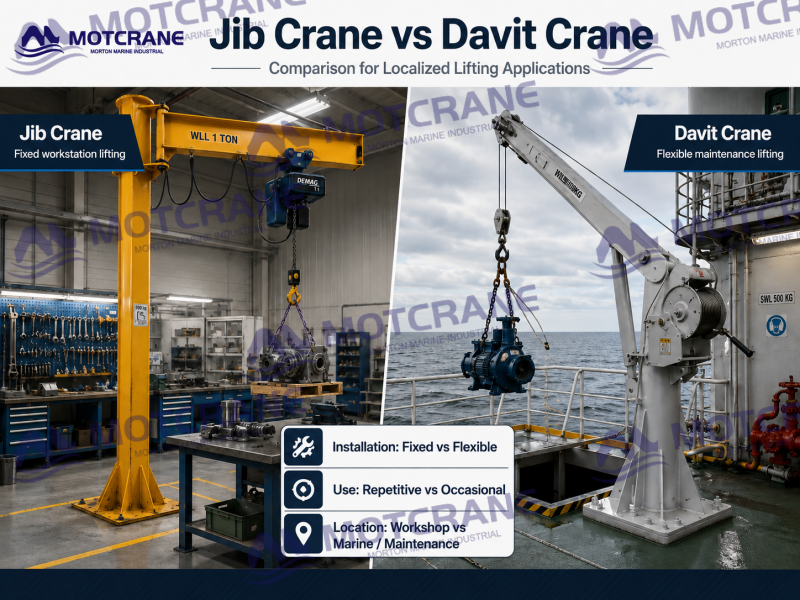
A jib crane is usually selected for fixed workstations, repetitive handling, and stable production workflows. A davit crane is more often used for maintenance lifting, temporary lifting, multi-location operation, marine applications, or confined spaces.
Choosing between the two should not be based only on lifting capacity or working radius. The better question is: how often will the crane be used, where will it be installed, does the site allow a fixed foundation or wall mounting, and does the lifting point need to change?
This guide compares jib cranes and davit cranes from structure, installation, mobility, application, maintenance, and cost, helping you choose a more suitable lifting solution for your project.
What Is a Jib Crane?
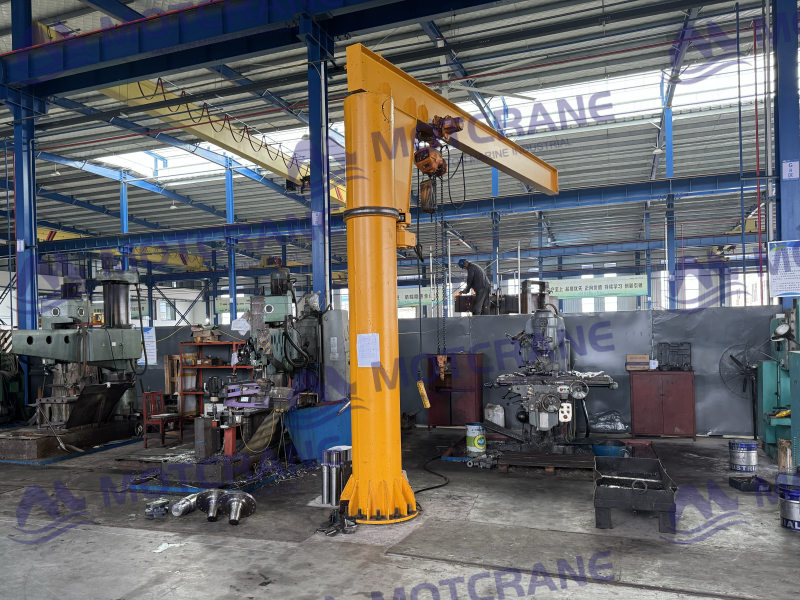
A ジブクレーン is a fixed localized lifting device commonly installed in workshops, warehouses, assembly lines, maintenance areas, docks, and fixed loading stations.
It usually consists of a column or wall-mounted support structure, a jib beam, a slewing mechanism, and an electric or manual hoist. Once installed, it can lift, move, and position materials within a defined working radius.
For workstations that handle parts, molds, tools, or small equipment every day, a jib crane helps reduce manual handling and keeps the lifting process more stable and repeatable.
Common types of jib cranes include:
- Column mounted jib crane
- 壁掛けジブクレーン
- Wall travelling jib crane
- Articulating jib crane
- Outdoor fixed jib crane
At MOTCRANE, jib cranes are not selected only by standard model. We usually review the site layout, installation condition, swing angle, lifting capacity, working radius, and frequency of use before recommending a suitable configuration.
What Is a Davit Crane?
A davit crane is a compact boom-type lifting device designed for flexible installation and localized lifting. It is commonly used for equipment maintenance, temporary lifting, ship deck operation, pump station service, offshore maintenance, and confined space lifting.
Compared with a fixed jib crane, a davit crane is usually lighter in structure and easier to deploy. Depending on the project, it can be supplied with a fixed base, socket-mounted base, removable structure, or mobile base.
Davit cranes are often used for low-frequency or intermittent lifting tasks, such as:
- Ship deck equipment maintenance
- Pump, motor, or valve removal
- Maintenance around pump pits and inspection wells
- Temporary lifting on offshore platforms
- Small equipment handling in confined areas
Common davit crane types include:
- Fixed-base davit crane
- Socket-mounted davit crane
- Portable davit crane
- Marine davit crane
- Offshore maintenance davit crane
For personnel rescue, marine classification, offshore operation, or special safety requirements, the crane must be reviewed according to the required standards. These applications should not be treated as ordinary material handling projects.
Jib Crane vs Davit Crane: Key Differences
1. Structural Design
A jib crane is normally designed as a fixed lifting system. It can be mounted on a concrete foundation, building column, steel structure, or wall. After installation, it mainly serves the same working area.
A davit crane is usually more compact and modular. Some designs can be quickly installed and removed through a socket-mounted base, while others can be supplied with a mobile base for flexible use.
In simple terms, a jib crane is more suitable for a long-term workstation. A davit crane is more suitable for maintenance, temporary lifting, and flexible lifting points.
2. Installation Requirements
A jib crane requires clearer installation conditions. A column mounted jib crane usually needs a foundation, while a wall mounted jib crane requires confirmation that the wall or steel structure can carry the load.
If the existing site does not have enough strength, additional foundation work, anchor bolts, or structural reinforcement may be required.
A davit crane offers more installation flexibility. It can be installed with a fixed base, socket base, or mobile base depending on the site. This makes it easier to use in areas where a permanent crane is not practical.
However, a davit crane still requires engineering confirmation. Base strength, mounting surface capacity, overturning moment, working radius, and site conditions must all be checked before use.
3. Mobility and Flexibility
Once installed, the working range of a jib crane is basically fixed. It is suitable for long-term lifting beside a machining center, assembly line, maintenance station, warehouse loading area, or fixed dock workstation.
The advantage of a davit crane is flexibility. For projects where lifting is needed in different locations from time to time, multiple bases can be installed, or a mobile structure can be selected. One crane can then serve several lifting points.
If the lifting task happens at the same location every day, a jib crane is usually more stable. If the lifting point changes frequently, a davit crane is often more convenient.
4. Usage Frequency and Work Intensity
Jib cranes are better suited for high-frequency and repetitive lifting.
For example, when a workshop needs to lift parts, molds, tools, or assemblies many times a day, a jib crane with an 電気ホイスト can support a steady working rhythm.
Davit cranes are more suitable for low-frequency and intermittent use. If lifting is only needed during maintenance, or when motors, pumps, valves, or small equipment need to be removed occasionally, a davit crane is usually a more practical choice.
Using a davit crane as a long-term production handling device is usually not the best solution, especially when the operation requires speed, repeated positioning, and stable workflow.
5. Working Radius and Coverage
A jib crane usually provides a larger working radius. Depending on the structure, it can rotate 180°, 270°, or 360°.
This makes it useful for fixed workstations where materials need to be lifted from one point and placed in another nearby area.
A davit crane can also rotate, but its working radius is usually smaller. Its purpose is not to cover a large area, but to complete a specific lifting task within a limited space.
6. Space Adaptability
A jib crane needs enough space for the foundation, column, jib rotation, and lifting clearance. If the workshop layout is compact or the ground cannot support foundation work, the selection must be reviewed carefully.
A davit crane is more adaptable in limited spaces. It is often used around pump pits, inspection wells, ship passages, platform edges, and equipment-dense areas.
Where larger lifting equipment cannot enter, a davit crane can work as a compact auxiliary lifting solution.
7. Indoor, Outdoor, Marine, and Offshore Applications
Jib cranes are commonly used in indoor workshops, warehouses, production lines, and fixed loading or unloading areas. For outdoor docks, yards, and shipyard workstations, the crane can be designed with corrosion-resistant treatment, weather protection, and a heavier structure.
Davit cranes are more common on ships, offshore platforms, pump stations, water treatment facilities, and maintenance platforms. These environments may involve humidity, salt spray, outdoor exposure, or limited installation space, so corrosion protection, material selection, and surface treatment become more important.
For coastal, marine, or offshore projects, lifting capacity and working radius are not enough. Classification requirements, corrosion protection, safety factors, and operating environment should also be confirmed in advance.
8. Maintenance Focus
For jib cranes, maintenance usually focuses on:
- Slewing bearings or slewing rings
- Jib beam and column structure
- Anchor bolts or wall connections
- 電動ホイスト, conductor rail, or cable system
- Limit switches and safety devices
For davit cranes, maintenance usually focuses on:
- Base and socket connections
- Removable components
- Slewing mechanism
- Corrosion protection and surface coating
- Manual or electric winch system
- Outdoor or offshore corrosion conditions
If the crane is used in marine, offshore, or outdoor environments for a long time, the maintenance plan should be stricter than that of ordinary indoor workshop equipment.
9. Cost Considerations
The initial cost of a jib crane is usually affected by foundation work, structural installation, electrical arrangement, and on-site mounting conditions.
If the site already has suitable foundation or wall support, the cost can be easier to control. If additional foundation pouring or structural reinforcement is needed, the total cost will increase.
The cost range of a davit crane can vary greatly. A small portable davit crane for simple maintenance work may be economical, while a marine davit crane with classification requirements, offshore corrosion protection, or special rescue functions can be much more expensive.
Therefore, it is not accurate to say one option is always cheaper. Cost depends on lifting capacity, working radius, structure, installation method, certification requirements, and actual working conditions.
For high-frequency lifting at a fixed workstation, a jib crane often provides better long-term value. For temporary lifting, multi-location use, or low-frequency maintenance work, a davit crane can be more cost-effective.
When Should You Choose a Jib Crane?
A jib crane is usually the better choice when the lifting task is fixed in one area and repeated every day.
Typical applications include:
- Loading and unloading CNC machining centers
- Material handling at assembly workstations
- Equipment assembly and disassembly at maintenance stations
- Loading and unloading in fixed warehouse areas
- Fixed lifting points at docks or shipyards
- Auxiliary lifting beside production lines
For manufacturing companies, the value of a jib crane is not only its lifting capacity. It helps create a stable workstation, reduce manual handling, and improve the efficiency of repetitive operations.
When Should You Choose a Davit Crane?
A davit crane is usually the better choice when the lifting task involves maintenance, temporary lifting, confined space operation, or multiple lifting points.
Typical applications include:
- Ship deck equipment maintenance
- Pump station and water treatment facility maintenance
- Pump, motor, or valve removal
- Lifting around inspection wells or confined spaces
- Temporary lifting on offshore platforms
- Locations unsuitable for permanent crane installation
For these projects, the crane may not be used every day. The key requirement is quick deployment, easy relocation, and safe lifting within limited space.
How MOTCRANE Helps Select the Right Solution
Each lifting project has different site conditions and working requirements. When selecting a jib crane or davit crane, MOTCRANE does not rely only on lifting capacity and working radius.
Before recommending a solution, we usually review:
- Whether the lifting task is fixed at one workstation
- Daily or weekly usage frequency
- Lifting capacity and maximum working radius
- Lifting height and available clearance
- Ground foundation or wall mounting conditions
- Whether the lifting position needs to change
- Indoor, outdoor, port, marine, or offshore environment
- Site obstacles and space limitations
- 電動ホイスト, manual hoist, or winch system requirements
- Corrosion protection, certification, or special safety requirements
With site photos, a simple layout sketch, lifting weight, working radius, and frequency of use, MOTCRANE can help determine which lifting solution is more suitable for the project and provide a matching technical configuration.
FAQ
1. Which is better for limited space, a jib crane or a davit crane?
It depends on the lifting task.
For temporary maintenance, multi-location lifting, or confined space operation, a davit crane is usually easier to deploy.
For a fixed workstation with repeated daily lifting, and where the site has suitable foundation or wall support, a jib crane is usually more stable.
In limited space, both options may be possible. The final selection depends on usage frequency, installation method, working radius, and whether the crane needs to be fixed or movable.
2. Which is more suitable for marine or offshore applications?
Both can be used in marine-related applications, but the working scenarios are different.
Jib cranes are more suitable for docks, shipyards, and fixed workstation lifting. Davit cranes are more commonly used on ship decks, offshore platforms, pump stations, and maintenance areas.
If the project involves classification society certification, offshore corrosion protection, or special safety requirements, these should be confirmed during the design stage.
3. Which one has a higher lifting capacity?
There is no simple answer based only on the crane type.
Jib cranes are often used for fixed and repetitive lifting with stable working conditions. Davit cranes can also be designed for heavier-duty applications, especially in marine, offshore, and maintenance projects.
The actual lifting capacity must be evaluated together with working radius, structure, installation foundation, and operating environment.
4. Which option is more cost-effective?
For fixed workstations with frequent use, a jib crane often provides better long-term operating value.
For temporary lifting, maintenance work, or multiple lifting positions, a davit crane may reduce installation work and offer more flexibility.
However, if the davit crane requires telescopic boom design, marine certification, offshore corrosion protection, or special safety functions, its cost can be much higher than a standard industrial jib crane.
The right comparison should be based on the same lifting capacity, working radius, application, and certification level.
5. Can the crane be selected only by lifting capacity?
No.
Even for 500 kg, 1 ton, or 2 ton lifting requirements, a fixed production workstation and a temporary maintenance point may require completely different crane solutions.
Working radius, installation condition, usage frequency, operating method, and available space should all be reviewed before selection.
Summary
Both jib cranes and davit cranes can solve localized lifting needs, but they are not designed for the same type of work.
For long-term fixed workstations and high-frequency repetitive lifting, a jib crane is usually more stable and better suited to production workflows.
For temporary lifting, maintenance work, multi-location use, confined spaces, marine applications, or offshore environments, a davit crane often provides more flexibility.
If it is not clear which option is more suitable, send モトクレーン the site photos, layout sketch, lifting capacity, working radius, and frequency of use. Our team can review the actual working conditions and recommend a more suitable lifting solution for your project.