


ワークステーションブリッジクレーンの設置要件:ワークショップに一台のクレーンを設置できるか?
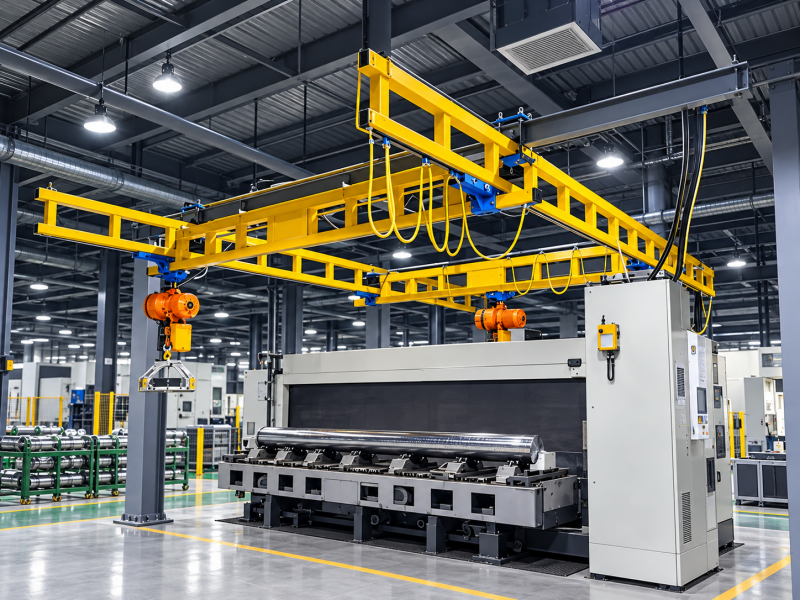
Your workshop may have enough floor space and headroom, but that does not guarantee you can install a ワークステーションブリッジクレーン. Before ordering, check the supporting structure, site access, electrical supply and acceptance requirements. These six checks help you assess installation readiness rather than choose between crane types. If you are still comparing equipment, see our comparison of workstation and conventional overhead cranes.
1. Can Existing Steel Beams Support a Ceiling-Mounted Crane?
Ceiling-mounted rigid-rail systems may be suspended from suitable H-beams or I-beams using engineered clamps. To assess your existing beams, record their depth, flange width and thickness, web thickness, steel grade and support span, together with existing loads. Complete dimensions are necessary, but they do not establish spare load capacity.
On your building plan, mark the proposed runways and suspension points. Request the crane’s suspension-point reactions and have a qualified structural engineer verify the beams, connections and building structure. If the arrangement is unsuitable, you can evaluate relocating the runways, adding engineered steelwork or using a free-standing system. Do not alter structural members or suspension fittings without an approved design.
2. Can the Floor and Anchors Support a Free-Standing Crane?
If you plan a free-standing system, its columns, baseplates and anchors transfer loads into the floor or foundations. Ask for the specified vertical and horizontal column reactions, including any uplift. Check concrete strength, slab thickness, reinforcement, ground conditions, anchor spacing and edge distances. Note nearby joints, buried services and existing foundations.
Your findings guide the foundation solution: use the existing slab with designed anchors, reinforce unsuitable areas or install dedicated foundations. Post-installed anchors may eliminate the need for pre-embedded bolts, but not for structural verification. Our foundation design guide explains the principles; do not copy foundation dimensions from a larger overhead-crane project.
3. Why Do Rail Alignment and Joint Accuracy Matter?
Even when your supports are secure, stepped rail joints, runway misalignment or uneven bolt tightening can increase rolling resistance and make the bridge or trolley jerk. Measure straightness, level, relative alignment and joint offsets against the tolerances for your selected system; visual checks are not enough.
One rigid-rail KBK configuration specifies a vertical joint offset of less than 0.3 mm; the limit is not universal. Test the bridge and trolley over their full permitted travel without a load. If either binds, stop and inspect the joint, fasteners and wheels before adjusting it. Never force the trolley through a faulty joint.
4. Can the Crane Be Delivered and Assembled on Site?
Your installation plan must allow space for each component to enter, be lifted and be assembled—not just for the finished crane. A typical free-standing system is assembled in stages: columns, crossbeams, runways, bridge and hoist. Some trolleys must be inserted from a rail end.
- Delivery access: Will the longest component pass through doors, internal routes and tight corners?
- Lifting equipment: Can suitable equipment reach and safely raise the components?
- Working at height: Can access platforms reach the runway and connection points?
- Assembly space: Is there room to stage components and insert trolleys at rail ends?
- Operating workshop: Will machinery obstruct installation, or is a shutdown needed?
If your rails cannot enter in one piece, agree on an engineered sectional layout before manufacture. Arrange lifting access or a production shutdown as needed; do not cut rails or relocate designed joints after delivery.
5. What Electrical Conditions Must Be Ready?
Your power supply must match the voltage, frequency, phase and installed power specified for the crane. Depending on the configuration, electricity may serve the hoist, bridge travel and trolley travel.
Size your incoming cable for total equipment power, expected simultaneous demand, route length, installation method and allowable voltage drop—not power alone. Allow full travel for festoon cables or conductor systems without snagging or tension. Ensure protective earthing and accessible isolation; if cranes share a supply, each must be isolatable. Have a qualified electrician confirm local compliance.
6. What Must Be Checked Before the Crane Enters Service?
Before accepting the crane, ask for checks of structural connections, anchors, runway joints and fasteners. Confirm that the hoist, bridge and trolley operate correctly and that brakes, controls, emergency stops, limit devices and other relevant protections function as specified.
Your acceptance process should include controlled no-load trials and any static or dynamic load tests required by applicable standards and the approved test plan. Review the recorded results, require defects to be corrected and ensure operators are trained before routine use. Test loads and procedures must be specified for your project, not copied from generic figures online.
For applicable underhung crane configurations, ASME B30.17 provides a reference for inspection and testing. Always follow the standards specified for your project.
Workstation Bridge Crane Installation Requirements: FAQs
Q1. Can I reuse an existing electric hoist?
Usually not without checking compatibility. I-beam trolleys must match the lower flange; KBK systems need the correct trolley and suspension. A matched assembly is generally preferable.
Q2. Can two bridges share the same runway?
Some systems allow it. Verify combined loads, support capacity and separation or anti-collision requirements.
Q3. Can manual travel be motorised later?
Sometimes, if mounting, drive and electrical provisions are planned now. For regular use, MOTCRANE generally recommends motorised travel from the start; compare the actual quotation difference.
Q4. Can the crane be relocated or the runway extended?
Modular systems can often be reinstalled after checks. Extensions require matching rails, supporting beams, columns and verified anchorage.
Q5. Is a standard indoor KBK system suitable outdoors?
Not automatically. Humidity, corrosion and exposure may require different finishes, electrical protection and maintenance.
結論
Before you request a final layout, describe how each load moves through your workshop: where you pick it up, where it travels and where you set it down. Include any turning, repeated positioning or simultaneous lifts. A marked-up plan and a short note are usually enough to explain the sequence.
Send MOTCRANE your workshop layout, lifting requirements, handling route and site photos. We can review the preliminary runway and support arrangement, flag constraints before final design and identify further checks. Have a qualified local professional verify the building and foundations.



 Japanese
 English
 Russian
 French
 Spanish
 Arabic
 Indonesian