+86 188 1666 3689 (WhatsApp)
ブログ
MOTCRANEブログ
What Is an Aluminum Gantry Crane? Types and Selection Guide
2026年 7月 29日

What Is an Aluminum Gantry Crane? Types, Applications, and Selection Guide


If you need a temporary crane for lifting loads of up to 5 metric tons in a workshop, warehouse, or suitable outdoor area, an aluminum gantry crane is often a practical choice. It can be assembled quickly, moved between work areas, and dismantled after use. It can also be customized according to capacity, span, hook height, travel route, number of operators, and frequency of use.

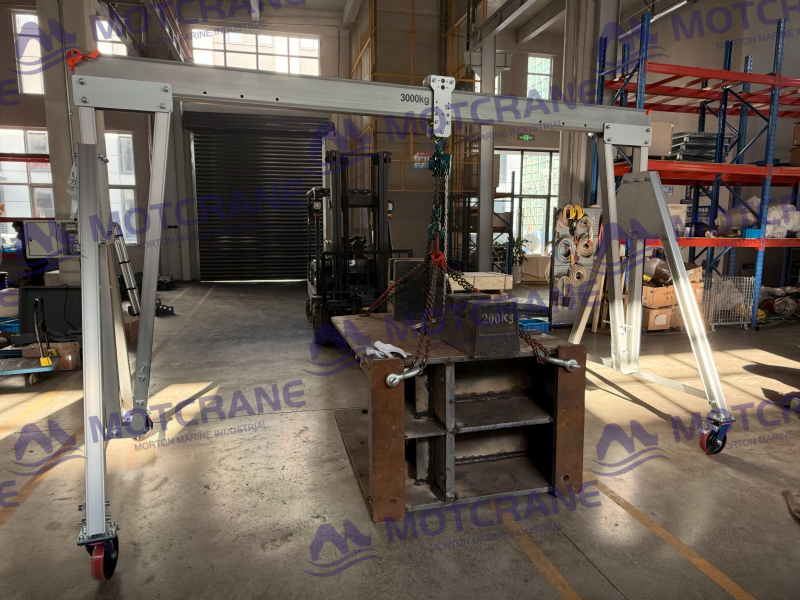
Aluminum gantry crane for equipment maintenance and temporary lifting

What Is an Aluminum Gantry Crane?


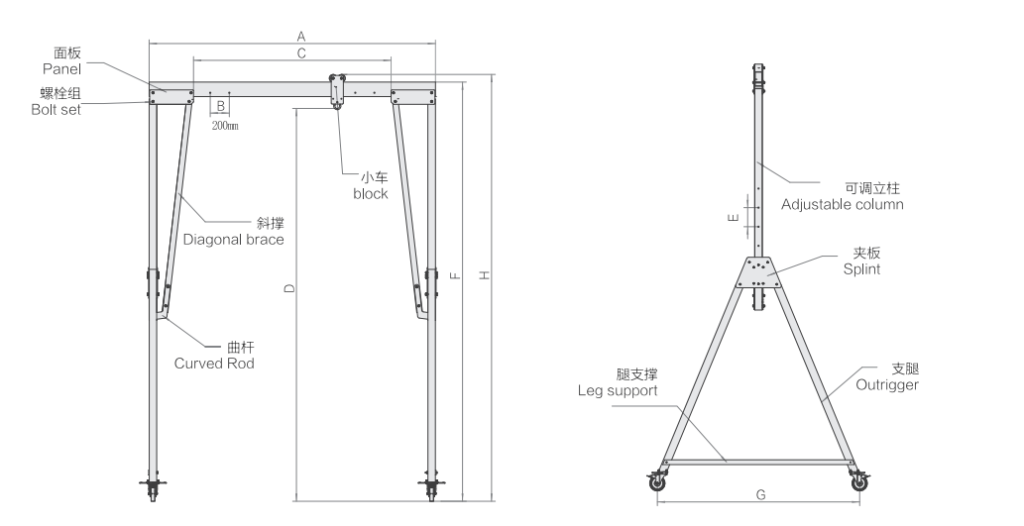
An aluminum gantry crane is a lightweight mobile lifting device made mainly from aluminum alloy. Its structure normally includes two end frames or adjustable legs, a main girder, a traveling trolley, a hoist, and casters.

It is commonly used for equipment maintenance, installation, temporary loading and unloading, production support, and suitable outdoor lifting. Depending on the application, it can use a manual chain hoist, electric chain hoist, or compact electric wire rope hoist.

Unlike a permanently installed overhead crane, it normally does not require runway rails, a concrete foundation, or a permanent supporting structure. It can be assembled at the work area and moved or dismantled after the job.

It may also be called a portable gantry crane or mobile gantry crane. These names generally describe a crane designed for portability, quick assembly, and use across multiple workstations.


How Does an Aluminum Gantry Crane Work?


The end frames support the main girder. A traveling trolley carries the hoist along the beam, allowing the load to be lifted and moved laterally.

A typical operation includes positioning the crane, locking the casters, aligning the hook above the load, adjusting the height or span if permitted, lifting the load, moving the trolley, and lowering the load into place.

Whether the complete crane can be moved while loaded must be confirmed according to the design, operating instructions, floor conditions, and working procedure. A crane should not be assumed to support loaded travel simply because it has casters. Manual pushing may also become difficult at full load, especially on uneven or sloped floors.


Common Types of Aluminum Gantry Cranes


  • Fixed-Height Aluminum Gantry Crane

A fixed-height model has the simplest structure and suits a workstation where the required height, span, and load dimensions rarely change. Depending on the span, height, and structural design, it can generally be designed for capacities of up to 5 metric tons.


  • Adjustable-Height Aluminum Gantry Crane

Adjustable-height aluminum gantry crane with pin-locked columns

An adjustable-height aluminum gantry crane is more suitable when load sizes vary or when the same crane must be used in different areas.

The height adjustment range can reach up to approximately 2 meters. The vertical columns usually contain adjustment holes spaced at 150 mm or 200 mm.

Two adjustment methods are common:

  • Manual column adjustment: Two operators raise the columns on both sides and secure them with locking pins.
  • Hand-crank adjustment: Two operators turn the cranks on both sides simultaneously, then lock the structure with pins.

Both sides should be adjusted gradually to keep the main girder level. Height adjustment should normally be carried out without a suspended load.

Depending on the span, maximum height, and structural design, adjustable-height models can generally be designed for capacities of up to 5 metric tons.


  • Foldable or Quick-Disassembly Aluminum Gantry Crane

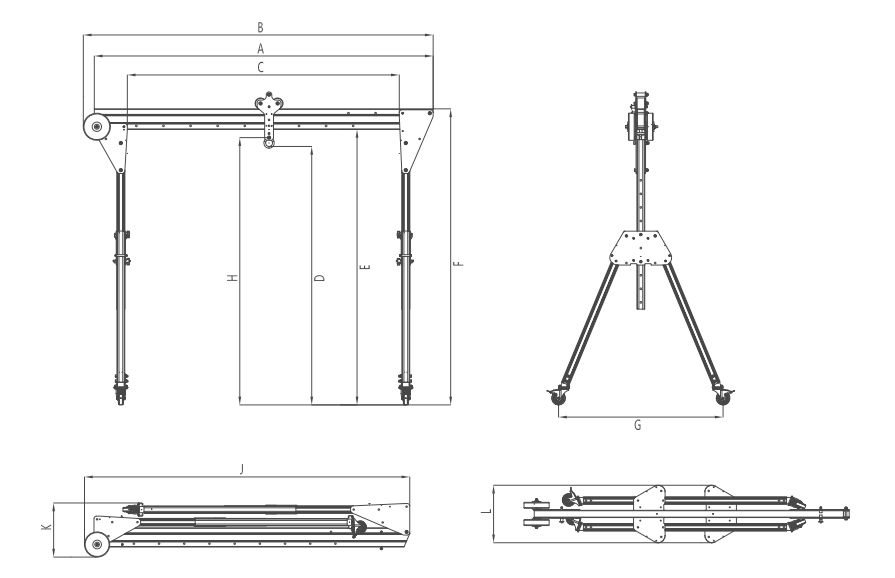
Foldable aluminum gantry crane for transport and quick assembly

This type suits projects requiring transport between workshops, maintenance areas, customer sites, or other locations.

Its modular or foldable structure reduces transportation and storage space and shortens setup time. These models are generally available from approximately 250 kg up to 1 metric ton. Final capacity still depends on span, lifting height, and structural arrangement.


What Applications Are Aluminum Gantry Cranes Suitable For?


Aluminum gantry cranes are mainly used for light- and medium-capacity temporary lifting, maintenance, installation, and relocation between work areas.

申し込み Typical lifting tasks
Workshop maintenance Motors, gearboxes, molds, pumps, and components
Equipment installation Pumps, motors, HVAC units, and production equipment
Vehicle maintenance Engines, transmissions, and assemblies
Laboratories and cleanrooms Precision equipment and lightweight components
Ship and offshore maintenance Valves, pump units, repair parts, and small equipment
Temporary loading and unloading Loading equipment onto trucks or unloading equipment on site

For truck loading and unloading, confirm the truck height, cargo height, required hook height, ground condition, and available working width before design.


Suitable Capacity, Duty Cycle, and Travel Method


Aluminum gantry cranes are commonly used for capacities from about 100 kg to 5 metric tons. Actual capacity depends on span, height, hook height, structural design, travel method, ground conditions, load dimensions, frequency of use, and hoist configuration.

They are generally more suitable for intermittent lifting than continuous production. If the crane must operate continuously for long periods, especially near its rated capacity, a steel portable gantry crane, overhead crane, or jib crane may be more suitable.

Manual pushing is more common below 3 metric tons. Above 3 metric tons, motorized travel should generally be considered. However, 3 metric tons is a practical reference rather than an absolute rule.

The final travel method should also consider crane dead weight, floor levelness and slope, caster size and material, rolling resistance, travel distance, available operators, and whether turning is required.


How to Select the Right Aluminum Gantry Crane


1. Determine the Required Lifting Capacity

The rated capacity should include the load, lifting attachments, slings, spreader beams, clamps, and any necessary allowance. For example, if the load weighs 2.8 metric tons and the lifting attachment weighs 300 kg, a 3-metric-ton crane is not sufficient.

2. Confirm Hook Height and Span

The maximum crane height is not the same as actual hook height. Confirm the load height, hoist headroom, hook travel, clearance above the load, width between the legs, and available overall height.

The space occupied by the trolley and hoist must be deducted when calculating actual hook height.

3. Confirm Mobility and Access

For a fixed workstation, a fixed-height structure may be sufficient. If the crane must move between workshops or project sites, consider an adjustable-height, foldable, or quick-disassembly design.

Check door and aisle dimensions, turning space, obstacles, and transport dimensions. A crane may fit inside the work area but still be unable to pass through the access route.

4. Select the Hoist

A manual chain hoist suits occasional lifting. An electric chain hoist is more suitable for repeated lifting, while a compact electric wire rope hoist can be selected when higher speed, greater lifting height, or a different control arrangement is required.

The hoist, trolley, main girder, power supply, capacity, control method, and any brand or certification requirements must be compatible.

5. Check the Floor and Working Environment

The floor must be level, solid, and capable of carrying concentrated caster loads. Check floor strength, slope, cracks, joints, obstacles, access dimensions, and turning requirements.

Outdoor, humid, salt-fog, cleanroom, laboratory, or windy conditions may affect caster selection, fasteners, hoist protection, electrical protection, surface treatment, and maintenance.


Aluminum Gantry Crane vs. Other Lifting Solutions


Lifting solution Best-suited applications Main characteristics
アルミニウム製ガントリークレーン Temporary lifting, maintenance, and relocation Lightweight, easy to dismantle, and quick to deploy
Steel gantry crane Higher-frequency or heavier-duty lifting Heavier structure, greater stability, and more configurations
天井クレーン Continuous workshop material handling Requires building support or a runway system
ジブクレーン Repeated lifting at one workstation Fixed coverage area


Common Selection Mistakes


Common mistakes include selecting capacity only from load weight, ignoring lifting attachments and hoist headroom, confusing crane height with hook height, assuming all caster-mounted cranes can move under load, ignoring floor slope and access routes, and using intermittent-duty equipment for continuous production.


よくある質問


  • Can an Aluminum Gantry Crane Be Disassembled for Transportation?

Yes. Most models use modular connections and can be dismantled for transport and storage. Follow the product manual for the correct procedure.

  • How Many People Are Needed for Assembly?

A small model can usually be assembled by one or two people. Larger cranes may require additional personnel or auxiliary lifting equipment.

  • Can an Electric Hoist Be Installed?

Yes, provided the hoist, trolley, beam, power supply, and rated capacity are compatible.

  • Does It Require a Concrete Foundation?

A permanent foundation is generally not required, but the floor must be level, firm, and capable of carrying the wheel loads.

  • Can It Be Used Outdoors?

Yes, if configured for the actual conditions. Wind, rain, snow, salt fog, uneven ground, and slope can affect safe operation.


概要


An aluminum gantry crane is suitable for projects that require quick deployment, temporary use, manual assembly, or frequent relocation without a permanent lifting system.

Selection should not be based on rated capacity alone. Span, actual hook height, height-adjustment method, floor condition, travel distance, loaded-travel requirements, operating frequency, available operators, access route, and working environment must all be considered.

If you are evaluating an aluminum gantry crane, send MOTCRANE your lifting requirements, including the required capacity, span, hook height, load dimensions, workflow, site photographs, ground conditions, and mobility requirements. Our engineering team can then determine whether a fixed-height, adjustable-height, foldable, or quick-disassembly structure is more suitable.

© 2026 Jiangsu Morton Marine Technology Co., Ltd. 無断転載を禁じます。.
jaJapanese